
EMC Question of the Week: April 27, 2026
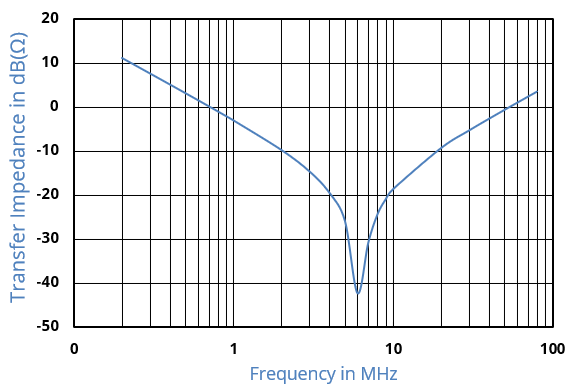
A 100-Ω transfer impedance expressed in dB(Ω) is
- 10 dB(Ω)
- 20dB(Ω)
- 40 dB(Ω)
- meaningless
Answer
The best answer is “c.” While the unit Ω (ohms) is neither a signal amplitude nor a signal power, transfer impedances are often specified in dB(Ω). For example, a current probe that produced 100 mV when measuring 10 mA would have a 10-Ω transfer impedance. The difference between the voltage and current expressed in dB would be 40 dB(mV) - 20 dB(mA) = 20 dB(Ω). The 10-Ω transfer impedance is equivalent to 20 dB(Ω). To convert the transfer impedance from ohms to dB(Ω), we can use the formula dB(Ω) = 20 x log(impedance in ohms).
While this is convenient and intuitive for specifying transfer impedances, resistances in general cannot (or should not) be specified in dB(Ω). Since resistance is not necessarily proportional to a signal amplitude or a signal power, the meaning of a resistance specified in dB(Ω) is not always clear. For example, the ratio of the power dissipated in a resistor to the square of the resistor current could also be specified in ohms. However, in that case, a more useful definition of dB(Ω) might be 10 x log(impedance in ohms).
We use a similar convention to express antenna factors using units of dB(m-1). For example, the received field strength in dB(μV/m) is equal to the measured voltage in dB(μV) plus the antenna factor in dB(m-1).
Both dB(Ω) and dB(m-1) can be convenient ways of expressing the ratio between two signal quantities with different units. However, it's important to understand the context before applying either of these quantities in a calculation.
Have a comment or question regarding this solution? We'd like to hear from you. Email us at