
EMC Question of the Week: February 23, 2026
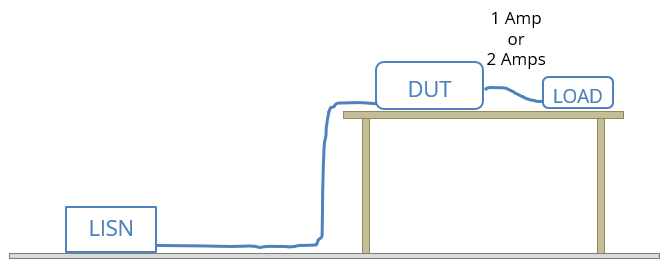
If the current drawn from a DC-to-DC converter increases from 1 A to 2 A, the differential-mode conducted emissions from that inverter will increase by approximately
- 3 dB
- 6 dB
- between 0 and 6 dB
- possibly less than 0 dB
Answer
The best answer is “d.” Changing the load impedance on a fixed-frequency DC-to-DC converter changes the duty cycle of the pulse-width modulation. The duty cycle is linearly related to the amount of DC current that the converter draws, but it is not linearly related to the amplitude of the switching harmonics. For example, the amplitude of the lower harmonics is highest at a 50% duty cycle. If increasing the load current from 1 A to 2 A caused the duty cycle to go from 40% to 80%, the amplitude of the lower harmonics would decrease (i.e., increase by less than 0 dB).
Changes in the amplitude of the higher harmonics are even less predictable. The location of nulls and peaks in the spectrum depends on the pulse width. The amplitudes of these harmonics go up and down as the duty cycle changes.
Another factor that impacts the measured emissions is the percentage of time the converter spends "coasting." In many applications, the power drawn from the converter varies with time. This can cause the converter to alternate between supplying a lot of current and supplying no current. This typically results in quasi-peak or average emissions that are well below the peak measured emissions.
Overall, there is no direct correlation between the current drawn from a power converter and its conducted emissions. One shouldn't assume that operating a converter at maximum load represents the worst-case.
Have a comment or question regarding this solution? We'd like to hear from you. Email us at