
EMC Question of the Week: August 26, 2019
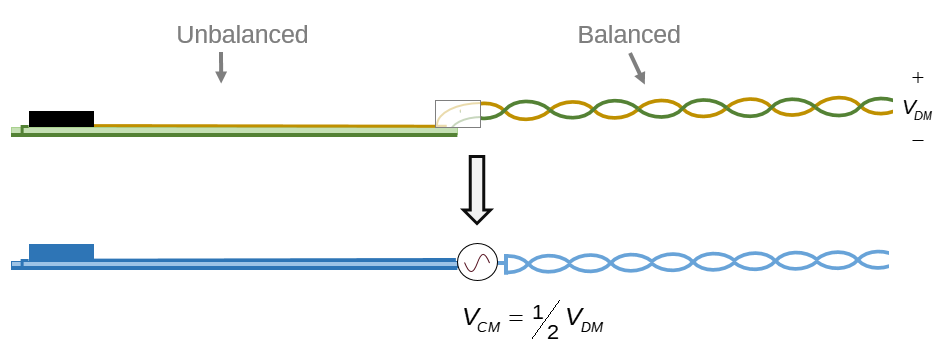
A signal flowing on a 2-conductor transmission line generates common-mode noise when it encounters
- an inductance in the return conductor
- a change in the characteristic impedance
- a change in the electrical balance
- an imbalance in the signal conductors
Answer
The best answer is "c". Conversion between differential and common mode propagation in transmission lines occurs if and only if there is a change in the electrical balance. This conversion has nothing to do with inductance or characteristic impedance; and signals propagating down unbalanced transmission lines will not experience mode conversion unless there is a change in the electrical balance.
In certain situations (e.g. discontinuities in very unbalanced transmission lines) it is convenient to estimate the common-mode voltage as a signal current times the partial inductance of a return conductor. Nevertheless, there is nothing inherently undesirable about inductance in a return conductor. Differential signals traveling down a trace pair or twisted wire pair generally rely on both conductors having the same relatively high partial inductance.
The general rule for avoiding mode conversion is, "If you're balanced, stay balanced. If you're unbalanced, stay unbalanced." Don't transition from a microstrip line to a twisted wire pair; and don't transition from a matched trace pair to a coaxial cable.
For more information on mode conversion and electrical balance, see the tutorial Introduction to Imbalance Difference Modeling .
Have a comment or question regarding this solution? We'd like to hear from you. Email us at