
EMC Question of the Week: November 30, 2026
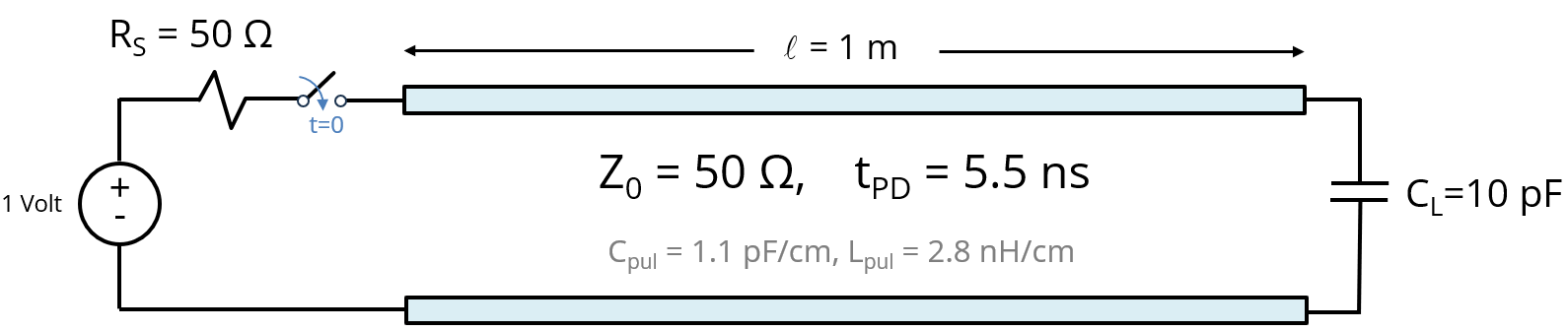
A 1-volt, 50-Ω source is connected by an ideal switch to a 10-pF capacitor through a 1-meter, 50-Ω transmission line as shown in the figure. 5.5 ns after the switch closes, the voltage across the capacitor starts to rise. What is the risetime (tr10-90) of the voltage step across the capacitor?
- <600 ps
- ~ 1 ns
- ~ 6 ns
- > 6 ns
Answer
The best answer is “b.” A 0.5-volt step travels down the transmission line and reaches the capacitor about 5.5 ns later. The capacitor initially looks like a short circuit to the arriving signal then quickly transitions to looking like an open circuit as the capacitor charges. The time constant of the transition is RC (50 Ω x 10 pF = 500 ps). The 10-to-90-percent risetime is 2.2 time constants, or approximately 1 nanosecond. There is an additional 0.5-volt step reflected back towards the source, but the source is matched and there are no further reflections.
Note that the per-unit-length capacitance of the transmission line is not part of the RC time constant calculation. This is because the transition is much faster than the propagation delay. If the capacitive termination had been much larger, and the source not matched, multiple reflections would have occurred while the capacitor charged. In that case, the RC time constant could be obtained by adding the line capacitance to the load capacitance.
Also note that the fall time associated with opening the switch is not the same as the rise time associated with closing it. In fact, the fall time is virtually infinite. Once the capacitor and the line are charged, there is no current in the switch. Opening it at that point doesn't change anything.
Have a comment or question regarding this solution? We'd like to hear from you. Email us at