
EMC Question of the Week: November 23, 2026
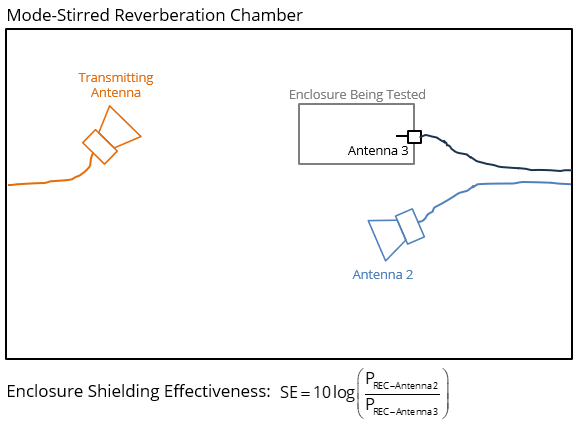
A three-antenna method for measuring the shielding effectiveness of an enclosure is illustrated in the figure. The power received by an antenna located inside the enclosure is compared to the power received by an antenna outside the enclosure. Measurements are made in a mode-stirred reverberation chamber. Using this method, the measured shielding effectiveness of the enclosure will usually depend strongly on the precise location of
- the Transmitting Antenna
- Antenna 2
- Antenna 3
- all of the above
Answer
The best answer is “c.” In a well-designed mode-stirred reverberation environment, the locations of the transmitting antenna and the receiving antenna outside the enclosure should not have much impact on the measurement. On the other hand, the fields inside the enclosure do not exhibit the same uniformity as the fields outside the enclosure. The fields inside the enclosure are always strong in some locations and weak in others.
This type of shielding effectiveness measurement yields different results depending on how well Antenna 3 is able to pick up the fields inside the enclosure. Is it picking up the electric field or the magnetic field? Is it located at an internal resonance peak or null? What is the polarization of the strongest internal field, and how does that compare with the polarization of the antenna?
Shielding effectiveness testing can yield useful information about the shielding integrity of an enclosure. However, it's important to remember that the actual attenuation provided by any given enclosure at any given frequency will depend strongly on the nature of the sources or receivers inside the enclosure and where they are located.
Have a comment or question regarding this solution? We'd like to hear from you. Email us at