
EMC Question of the Week: September 7, 2026
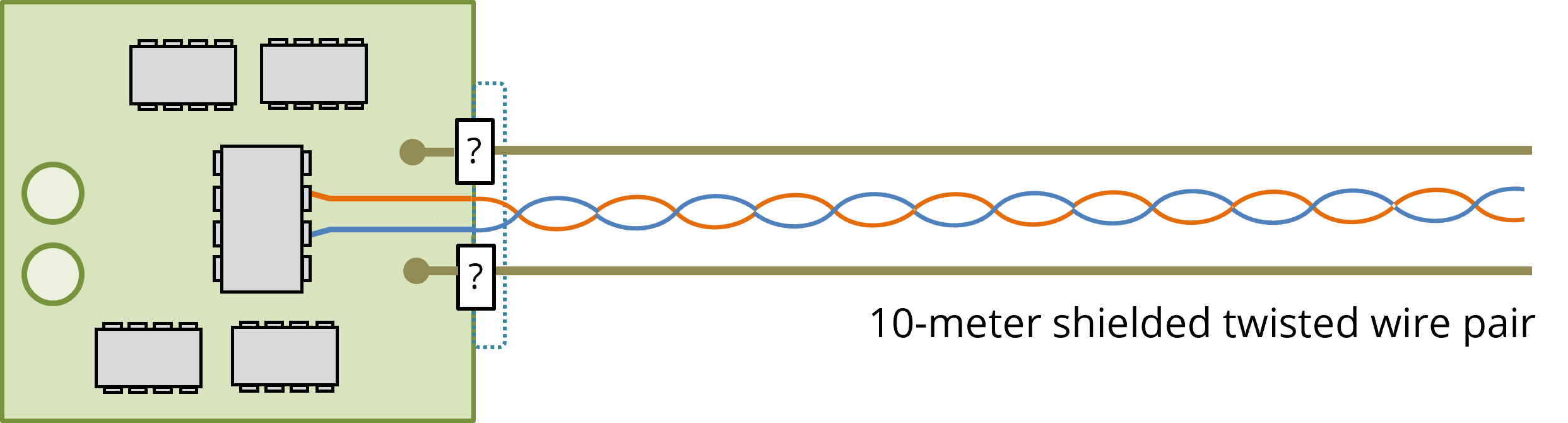
A small (4-cm x 3-cm) sensor board communicates with a controller board using a pseudo-differential interface (e.g., USB or CAN). The cable connecting the two devices is a shielded twisted wire pair. The cable shield is connected to the chassis ground at the controller end, but the sensor board is in a plastic enclosure with no metal chassis. In this case, the shield of the cable should connect to the sensor board ground plane through
- nothing (open circuit)
- connector pins (short circuit)
- TVS diodes
- ferrites
Answer
The best answer is “b.” To meet high-frequency emissions and immunity requirements, the shield needs to make a good high-frequency connection to the sensor board ground plane. Normally, this is best accomplished by connecting directly to the planes through connector pins on both sides of the connector. In rare situations, where the sensor board ground must be DC isolated from the controller chassis ground, it would be necessary to put a chassis ground plane on the sensor board and tie it to the sensor ground through capacitors.
Leaving the shield unconnected at the sensor board would negate any benefit the shield might otherwise provide. High-frequency noise would couple to the sensor/controller interface and other circuits on both ends with approximately the same amplitude as if the shield were missing.
Connecting through TVS diodes would not provide any transient protection. For the most part, it would be similar to leaving the shield unconnected.
Since the goal is to provide a low-impedance connection to the board's EMC ground, ferrites would not provide any benefit relative to a direct connect through the connector pins. Their location near the end of a 10-meter cable means there would be very little common-mode current for them to attenuate. And any voltage dropped across them would drive the sensor board relative to the cable shield.
Note: Situations like this, where a small board in a plastic enclosure connects to a long cable, are common. With a good layout, these boards usually meet all their EMC requirements without elaborate filtering or shielding. In fact, when these boards do have EMI problems, it is often due to unnecessary and inappropriate filtering (e.g., common mode chokes and ferrites).
Have a comment or question regarding this solution? We'd like to hear from you. Email us at