
EMC Question of the Week: August 31, 2026
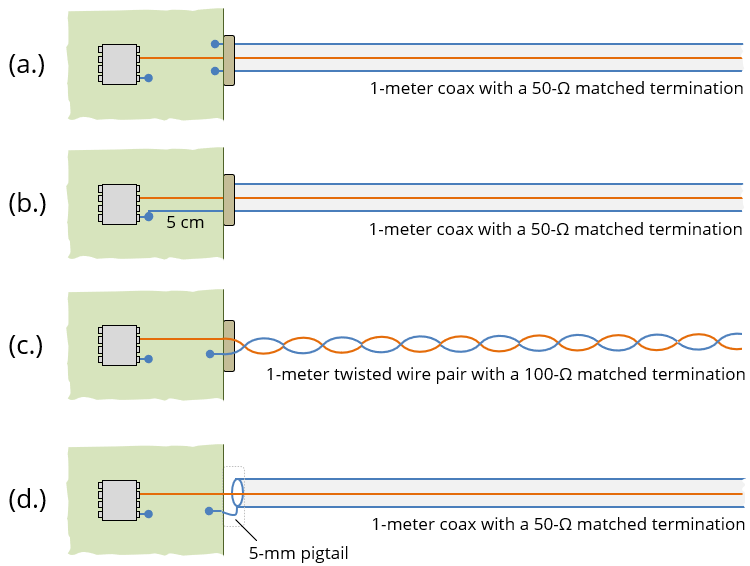
A 1.0-volt, 100-Mbps, single-ended signal driver sends a signal to a matched load on a 1-meter cable. Which of the following cable options is least likely to cause a radiated emissions problem?
- coax with shield grounded at connector
- coax with shield grounded at source location
- twisted wire pair with one wire grounded at connector
- coax with shield grounded through a 5-mm pigtail
Answer
The best answer is “a.” As long as the cable shield makes a good connection to the board on both sides of the center conductor, the nominal voltage driving the coaxial cable shield is close to zero. (This assumes the ground plane area is much greater than the signal trace area.)
The worst driver design is Option (c.). The main issue here is that an unbalanced signal source is driving a balanced cable. The common-mode voltage driving the twisted-pair cable at 100 MHz is 230 mV. This is 47 dB above a nominal target voltage of 1 mV and is strong enough to virtually guarantee a radiated emissions failure in typical system configurations. Even if the transition time is controlled, every odd harmonic below a few GHz is driving the cable hard enough to exceed a radiated emissions specification.
Options (b.) and (d.) are also pretty bad. They both put inductance in the signal return path. Assuming this inductance is on the order of 5 nH (e.g., a 5-cm trace or a 5-mm pigtail), the common-mode voltage driving the cable shield at 100 MHz and every odd harmonic is about 28 mV (signal current times ωL). This is 29 dB above the target voltage and is still likely to cause a radiated emissions problem.
Note that shielding the twisted pair in Option (c.) could reduce the radiated emissions but would still be a poor design. In this case, a 5-mm pigtail connection on the wire-pair shield would produce emissions comparable to Option (d.). High-frequency, single-ended signals generally require unbalanced transmission lines. High-frequency differential signals generally require balanced transmission lines.
Have a comment or question regarding this solution? We'd like to hear from you. Email us at