
EMC Question of the Week: August 24, 2026
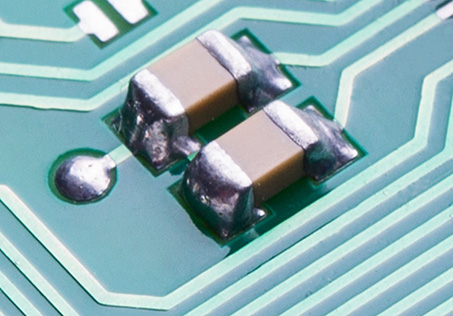
Class II ceramic capacitors (e.g., X7R) have a capacitance that decreases with an applied voltage. Nevertheless, they are well-suited for
- DC power bus decoupling
- AC power bus decoupling
- high-pass filtering
- none of the above
Answer
The best answer is “a.” Class II ceramic capacitors are widely used for DC power bus decoupling at high frequencies. At the frequencies where they are most effective, the connection inductance is much more important than the nominal capacitance. Class II ceramic capacitors can pack the more capacitance into a smaller package size than Class I ceramic capacitors (e.g., NP0).
On an AC power bus, the large voltage swings across the capacitor cause the nominal capacitance of a Class II ceramic capacitor to vary with time. This distorts the AC waveform and introduces harmonics.
The time-varying voltages across a Class II ceramic capacitor can also introduce harmonics in high-pass filtering applications.
Note: The relatively large DC voltage in a power bus decoupling application ensures that the capacitance variation due to noise voltages is small at frequencies below the first self-resonance of the capacitor. At higher frequencies, currents are confined to the lower plate pairs in the capacitor package. This reduces the capacitance significantly, but it doesn't matter because the component impedance is determined by the connection inductance.
Have a comment or question regarding this solution? We'd like to hear from you. Email us at