
EMC Question of the Week: July 6, 2026
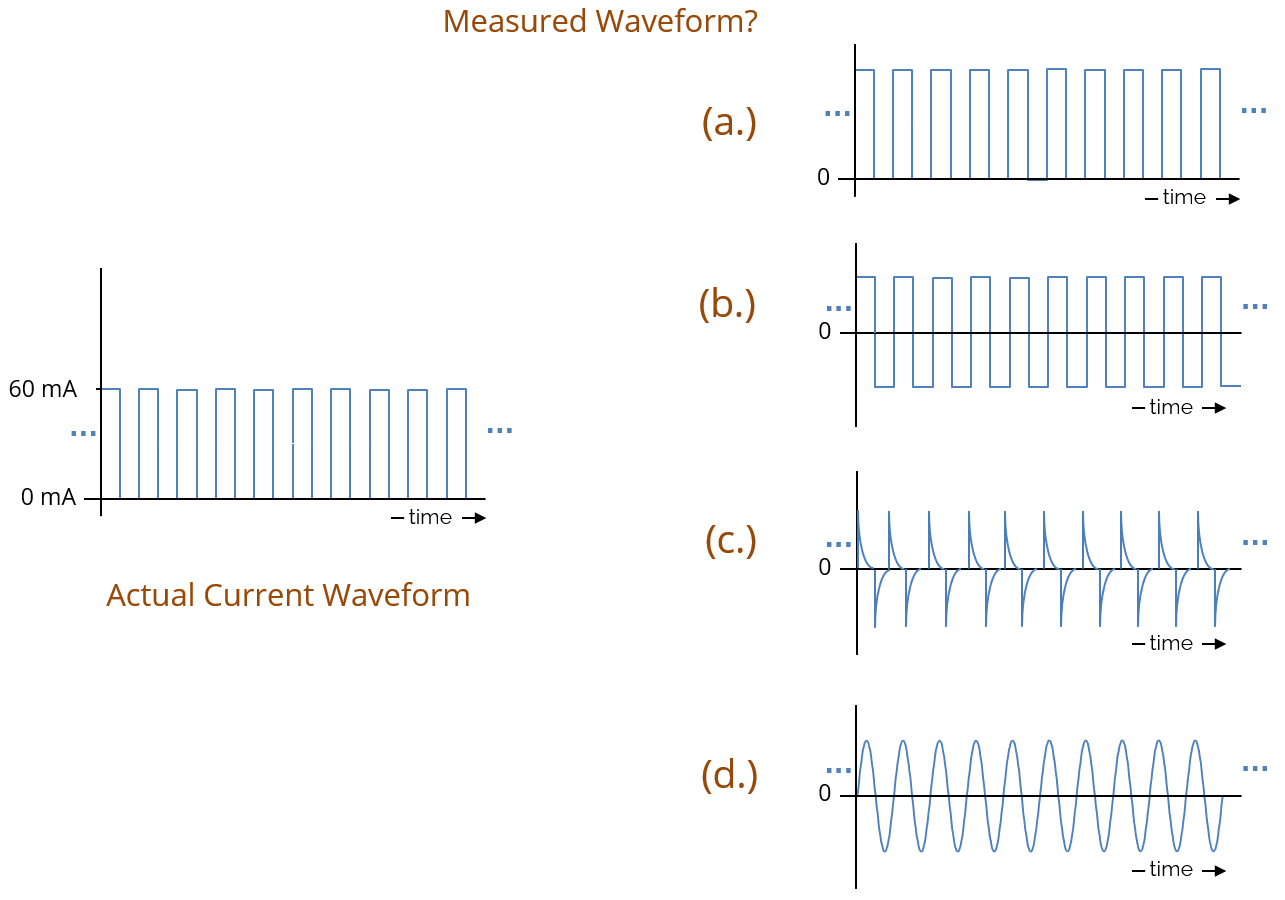
A small loop magnetic-field probe is placed on a circuit board trace. The trace carries a current with a waveform that looks like a 60-mA, 250-MHz square wave. The magnetic-field probe's loop inductance is 15 nH. When connected to a 50-Ω oscilloscope input, we measure a voltage waveform that looks like
- the current waveform
- the current waveform with no DC component
- pulses corresponding to positive and negative transitions
- a 250-MHz sine wave
Answer
The best answer is “c.” The voltage picked up by a small loop probe is proportional to frequency as long as the inductive reactance of the probe is small relative to the resistance of the scope input. So, at low frequencies, the measured waveform resembles the derivative of the magnetic field's waveform. In this case, the voltage rises suddenly and decays with a time constant, τ = L/R = 300 ps. If the inductance had been much higher (e.g., as it often is in an RF current probe), the waveform voltage would fall much more slowly, and the measured waveform would start to resemble the actual current waveform without its DC component, as shown in (b.).
At frequencies where the inductive reactance of the loop is greater than the scope input impedance, the measured voltage is no longer a function of frequency. The boundary between the low-frequency and high-frequency behavior occurs when ωL = R (or f = R/2πL). In this example, that boundary frequency is
If the inductance of the probe or the fundamental frequency of the waveform were much higher, all harmonics of the waveform would have fallen above the boundary frequency. In that case, the measured waveform would have had a shape similar to that of the current waveform without the DC component.
Have a comment or question regarding this solution? We'd like to hear from you. Email us at