
EMC Question of the Week: May 11, 2026
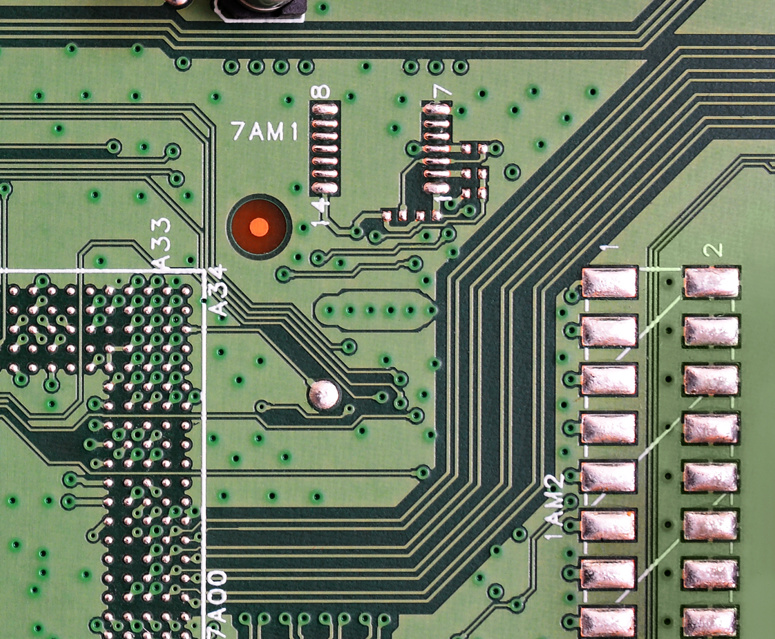
Differential signal trace pairs on the outer layer of a printed circuit board 0.25 mm or less over a solid copper plane should generally
- be tightly coupled
- be length matched
- have coplanar ground
- all of the above
Answer
The best answer is “b.” If the traces are not length-matched to an appropriate tolerance, the common-mode spike observed by the receiver and reflected back onto the trace pair can contribute to an EMC or signal integrity problem. The allowable tolerance will depend on many factors, but is generally a fraction of the propagation distance associated with the signal transition time.
Employing tightly coupled traces (i.e., traces very closely spaced relative to their height above the plane) typically creates more problems than it solves. Yes, the fields drop off more quickly with distance, and the radiated emissions directly from the traces are reduced. But those issues are rarely significant for typical printed circuit board geometries. More importantly, tightly coupled traces are more difficult to route while maintaining a constant impedance. They also require a more complex termination in order to match both differential-mode and common-mode propagation.
In situations where the trace pair is already 0.25 mm or less above a copper plane, coplanar ground (copper on the same layer as the trace pair) is rarely necessary or helpful. Like tight coupling, coplanar ground is more likely to create problems than solve them. Ground on the trace layer has virtually no effect on coupling to or from the trace pair. Instead, if it is not well-connected to the ground layer below it, the presence of ground on the signal layer introduces opportunities for resonances in the ground structure.
Of course, the situation changes if the ground plane is 1 mm or more below the trace pair. In this case, a much stronger argument can be made in favor of tightly coupled traces and coplanar ground. Technical papers with measurements and simulations that support these features are typically based on boards with a thick layer spacing. But real-world designs today are very unlikely to rely on differential traces routed that far from a plane. Like virtually all EMC and signal integrity design guidelines, it's important to understand why the guideline exists and when it applies.
Have a comment or question regarding this solution? We'd like to hear from you. Email us at