
EMC Question of the Week: March 30, 2026
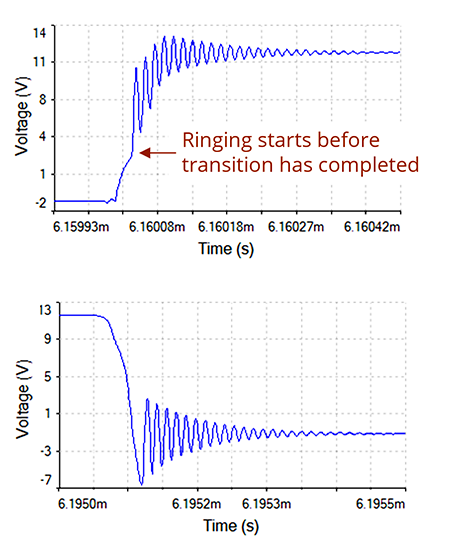
The voltage waveform on the switch node of a buck converter exhibits ringing. The ringing on the low-to-high transition is different from the ringing on the high-to-low transition as indicated in the figure. What is the primary source of the ringing on the low-to-high transition?
- load capacitance
- load inductance
- mismatched load
- reverse-recovery current
Answer
The best answer is “d.” When a silicon MOSFET or diode transitions from a closed circuit to an open circuit, it emits a pulse of "reverse-recovery" current. In a buck converter, this current pulse flows out of the low-side switch (or diode), through the high-side switch, and back to the low-side switch through the power bus decoupling capacitance. It sees very little resistance, so the path inductance rings with the open switch (or diode) capacitance. This path does not involve the load, so the load impedance has little impact on this ringing.
A key indication that ringing is caused by reverse recovery current is that the ringing will typically begin before the output has fully transitioned. On the other hand, ringing associated with a load inductance or capacitance will manifest itself as an overshoot/undershoot oscillation.
For switch nodes with large surface areas, this ringing can be coupled to nearby circuits and cause conducted or radiated emissions problems. When this is an issue, snubber circuits across the switch terminals can provide an alternative, lossy path for the reverse recovery current that dampens the ringing. Snubber circuits are often required on high-power inverters or motor drivers, though they are rarely necessary on the low-to-medium power DC-to-DC converters found on typical circuit boards today.
Note that wide bandgap switches (e.g., SiC or GaN) do not create a significant reverse recovery current. This is one of the many advantages that these devices have compared to traditional silicon switches.
Have a comment or question regarding this solution? We'd like to hear from you. Email us at