
EMC Question of the Week: March 16, 2026
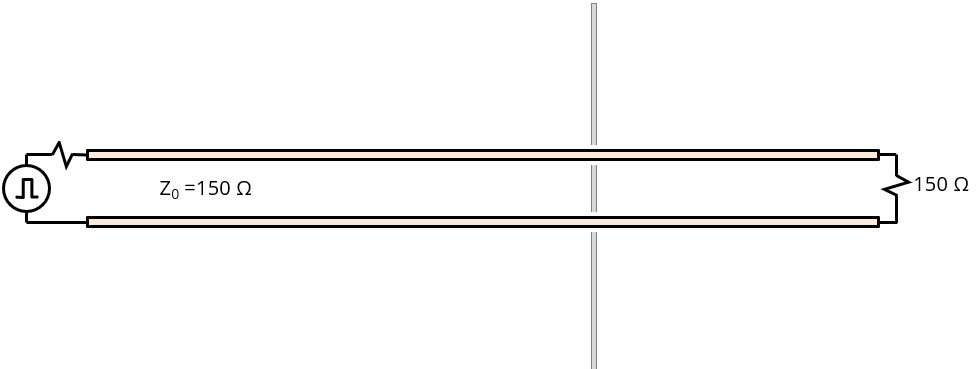
A 10-Mbps differential digital signal propagates along two parallel 1-mm diameter wires. The edge-to-edge spacing between the wires is 3 mm. At some point, the wire pair passes through two holes in a 1-mm-thick metal plate. Each hole has a diameter of 1.5 mm, so the wires maintain a 0.25-mm clearance and do not contact the plate. To determine the impact of the plate on the signal integrity, the plate is best modeled as a
- plane-wave reflector
- lumped inductance
- lumped capacitance
- frequency-selective surface
Answer
The best answer is “c.” The plate briefly reduces the characteristic impedance and therefore behaves like a shunt capacitor connecting the two wires. This capacitance will be on the order of picofarads, so a 10 Mbps signal with a properly controlled transition time would not be significantly impacted by the plate. However, at much higher frequencies, a significant reflection would occur.
The plate does not behave like a plane-wave reflector because the wires guide the wave energy through the holes in the plate. As the plane wave strikes the plate, currents induced on the front surface of the plate bring charge to/from the holes, where it flows to the other side of the plate. The currents on the back surface of the plate recreate the plane wave on the other side. At low frequencies, this occurs without significantly disrupting the power flow.
The discontinuity is modeled as a shunt capacitance (not inductance) because it briefly lowers the characteristic impedance. A discontinuity that briefly increased the characteristic impedance (such as a temporary widening of the spacing, or a temporary reduction in the wire diameter) would be modeled using a series inductance.
Finally, the plate is not a frequency-selective surface, and there is no advantage to trying to model it as one.
Have a comment or question regarding this solution? We'd like to hear from you. Email us at