
EMC Question of the Week: January 14, 2019
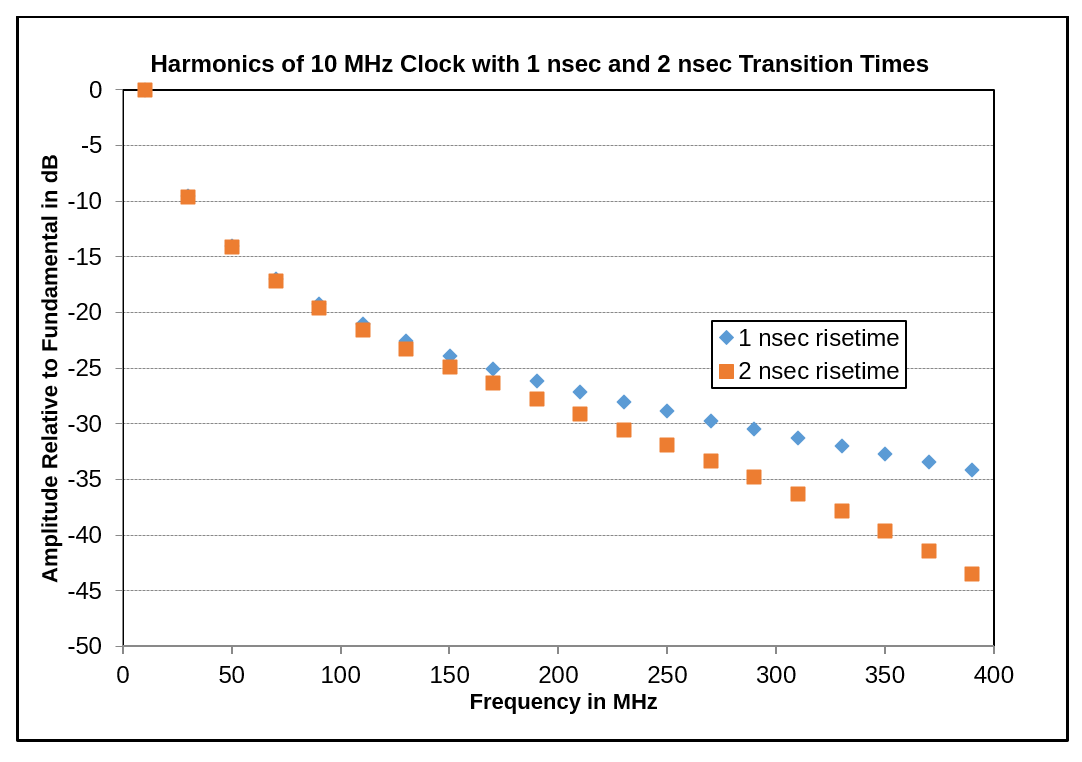
If the transition time of a 10-MHz clock signal changes from 2 nanoseconds to 1 nanosecond, the amplitude of the harmonic at 50 MHz
- decreases by approximately 6 dB
- stays approximately the same
- increases by approximately 3 dB
- increases by approximately 6 dB
Answer
The correct answer is "b." While increasing the transition times of a digital waveform can significantly decrease the amplitude of the upper harmonics, the change from 1 nsec to 2 nsec is not enough to reduce the amplitude of the harmonic at 50 MHz significantly. The knee frequency (i.e. the frequency above which harmonics start to fall off with the square of the frequency) is fknee = 1/πtr. With a 1 nsec transition time, the knee frequency is 318 MHz. With a 2 nsec transition time, the knee frequency is 159 MHz. In both cases, the transition time is not long enough to affect the harmonic at 50 MHz significantly.
The plot on the right shows the relative amplitudes of the first 20 odd harmonics for this example. The harmonics of the waveform with the 1-nsec transition time are decreasing at a rate of 20 dB/decade over most of the frequency range shown. The harmonics of the waveform with the 2-nsec transition time begin to drop off more rapidly at frequencies above the 159 MHz knee frequency.
The waveform harmonics at 50 MHz are approximately the same amplitude. They are both about 14 dB below the fundamental with the 1-nsec harmonic at -14.0 dB and the 2-nsec harmonic at -14.1 dB.
Note that the period of the waveform is 100 nsec. Two nanoseconds is still a very sharp transition time. The power in the harmonics above 100 MHz could be reduced significantly by slowing the transition times even more.
Have a comment or question regarding this solution? We'd like to hear from you. Email us at