
EMC Question of the Week: August 20, 2018
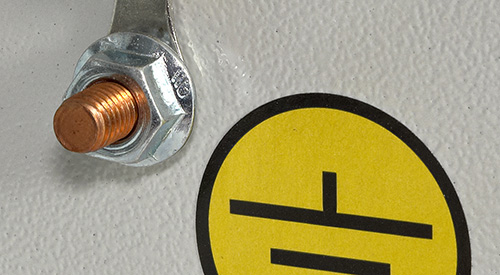
Eventually, a connection between a copper wire and an aluminum screw may exhibit
- an increase in resistance due to galvanic corrosion
- a decrease in resistance due to galvanic corrosion
- an increased voltage due to triboelectric charging
- tin whiskers
Answer
The correct answer is "a". When two dissimilar metals come into contact in an electrolyte, one metal acts as an anode and the other as a cathode depending on their relative position in the Galvanic Series. Electron migration between the metals results in an accelerated corrosion of the anode material. For a copper/aluminum connection, aluminum is the anode material. The electrolyte is typically moisture with small amounts of impurities. The corrosion forming on the aluminum surface has a much higher resistivity than either of the two metals, causing the resistance of the connection to increase with time. For this reason electrical bonds made between dissimilar metals often require an intervening material, such as a plating to reduce the likelihood of galvanic corrosion.
Triboelectric charging refers to the charge separation that occurs when insulating materials are separated too quickly. Tin whiskers are long whisker-like projections that emanate over time from materials containing tin (particularly tin solder).
Have a comment or question regarding this solution? We'd like to hear from you. Email us at