Chapter 10 Exercise: Low-frequency Magnetic-field Shielding
Lines of magnetic flux don't start or stop; they form loops. Magnetic-field shielding doesn't stop the field; it redirects it. This lab investigates the ability of various materials to redirect a low-frequency magnetic field.
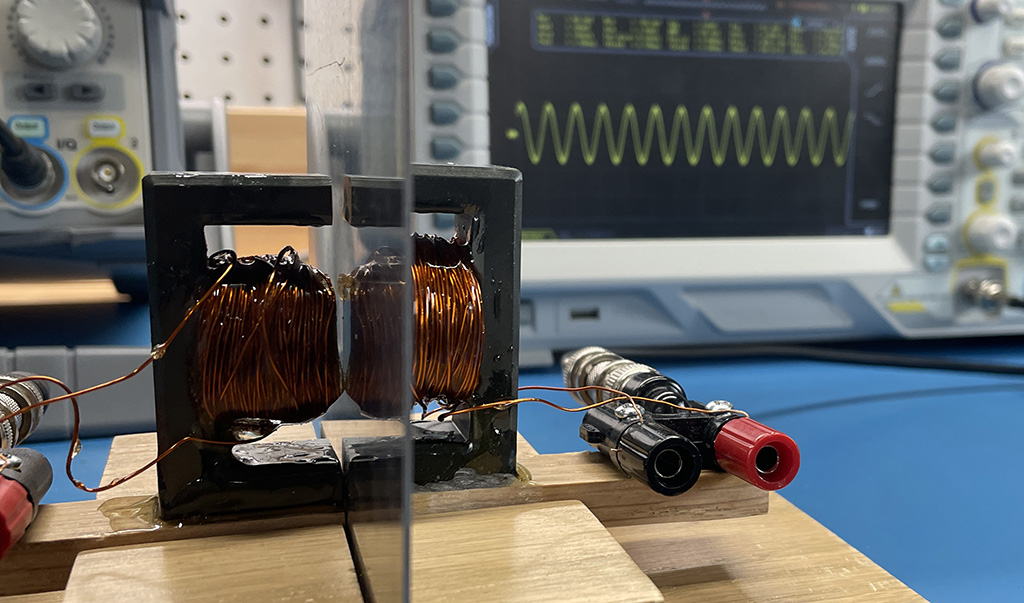
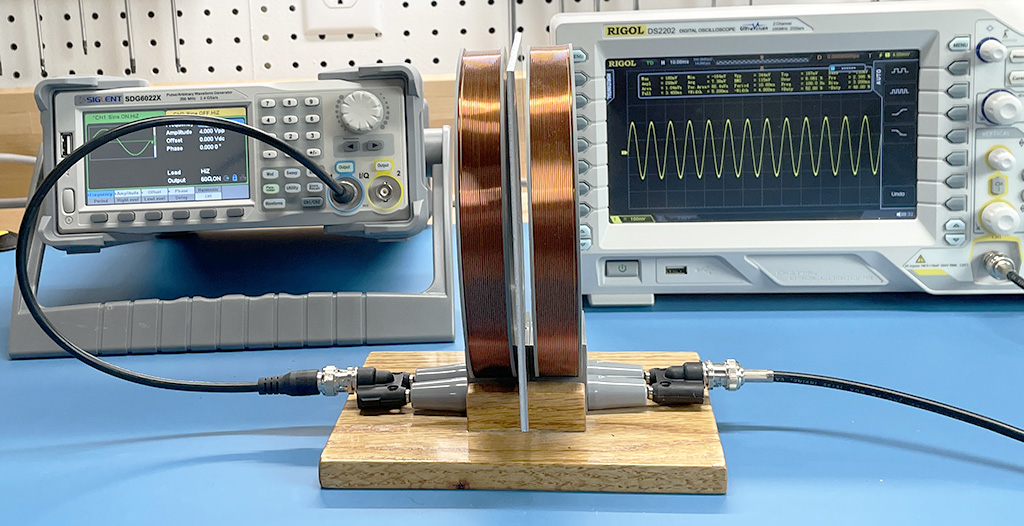
Preparation: This lab requires a test fixture that is essentially two coils of wire with a space between them. This can be as simple as a pair of wire loop probes held in a fixed position, or more elaborate fixtures like the one shown in the figure.
Equipment Required:
- sinusoidal waveform generator or an AC power source (50-100 Hz)
- oscilloscope
- test fixture comprised of two coils with strong magnetic-field coupling
- samples of various materials (conductive and non-conductive, magnetic and non-magnetic)
- permanent magnet
Procedure:
Step 1: Connect the signal generator to the first coil and the oscilloscope to the second coil. The coils should be positioned to maximize the magnetic field coupling, but with a gap between them to allow the insertion of the shielding material samples.
Step 2: Adjust the oscilloscope until it shows a clean sinusoidal signal with an amplitude that nearly fills the screen. (It may be helpful to use the oscilloscope's internal bandwidth limiting to reduce the high-frequency noise picked up from other sources in the building.)
Step 3: Place a material sample between the two coils and note the amplitude of the received voltage with and without the material in place. Record the attenuation in decibels.
Step 4: Repeat the previous step for each of the sample materials.
Step 5: Make a table showing each of the materials and its respective attenuation. What do the materials with the highest attenuation have in common?
Step 6: Try attaching the permanent magnet to each of the materials. Add another column to the table indicating whether or not each material was attracted to the magnet.
Notes:
It is helpful to have various thicknesses of the same type of steel among the test samples. Thicker samples will yield greater attenuation than the thinner samples due to their lower magnetic reluctance.
Even a material with infinite permeability wouldn't be a perfect shield. Magnetic flux still passes through the material and continues through the air on the other side. The most effective test fixtures are those that capture the flux and bring it around to the back of the first coil without traveling very far through the air, like the one shown below.