
Chapter 2 Lab Exercise: Path of Least Impedance
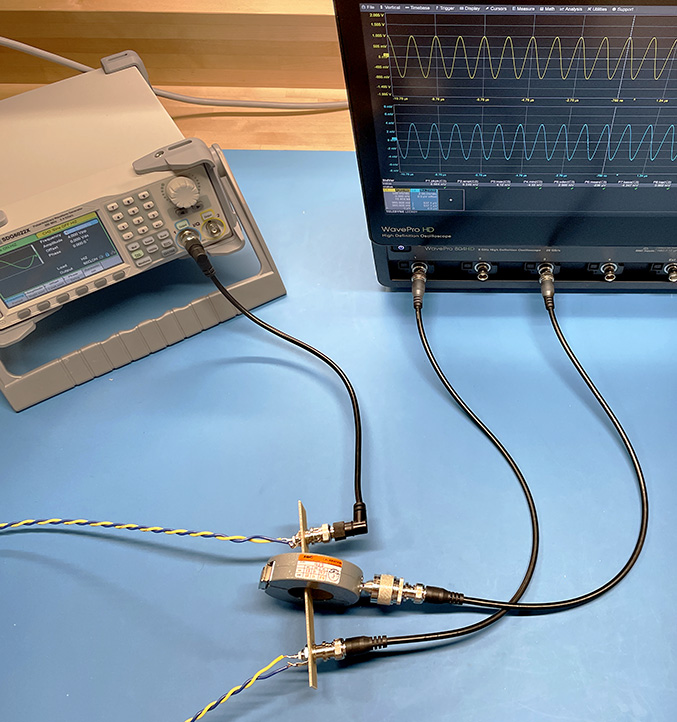
EMC problems are often the result of a failure to recognize that signals have current, and that the path these currents take is important. This classic laboratory exercise is designed to illustrate that signal currents return to their source. The path of low-frequency return current can be very different from that of the high-frequency return current.
Preparation: This experiment is described in Chapter 2 with a coaxial cable. Students should be asked to speculate about how the results would be different with a twisted wire pair prior to making the measurement.
Equipment Required:
- 2-channel oscilloscope
- RF signal source (100 Hz to 10 MHz)
- coaxial cable and twisted-wire-pair cable about 1 or 2 meters long
- RF current probe (100 Hz to 10 MHz)
- short plate or strap just long enough to pass through the current probe
Procedure:
Step 1: Connect the signal source to one end of the long cable. Terminate the other end with a 50-Ω resistor or a 50-Ω input of the oscilloscope. Use the shorting strap to connect the ground conductors of the long cable together near the ends.
Step 2: Position the current probe around the shorting strap and connect it to the second oscilloscope channel.
Step 3: At frequencies between 100 Hz and 10 MHz, adjust the source amplitude measured across the 50-Ω cable termination to 1 Vpeak. This corresponds to a current of 20 mApeak.
Step 4: Record the peak current passing through the shorting strap.
Step 5: Plot the percentage of the total current that returns through the shorting strap as a function of frequency from 100 Hz to 10 MHz.
Step 6: Repeat Steps 1-5 using the twisted wire pair cable.
Step 7: In each case, is the percentage of current returning on the strap near zero above 1 MHz? If not, why not?
Notes:
The high-frequency return path for the twisted wire pair has a higher resistance and a higher inductance than the return path for the coaxial cable. Also, the coaxial cable is self-shielded, so current is forced to return on the inside of the outer conductor at any frequency where the thickness of the shield is much greater than the skin depth, regardless of the path inductance.
It is also worth noting that the twisted wire pair is balanced. As described in Chapter 7, when connected to an unbalanced source and unbalanced load (oscilloscope), there is a measurable common-mode current on the cable. At the frequencies of this measurement, this common-mode current should not significantly alter the results.