
Chapter 2 Lab Exercise: Measuring the Inductance of a Wire Loop
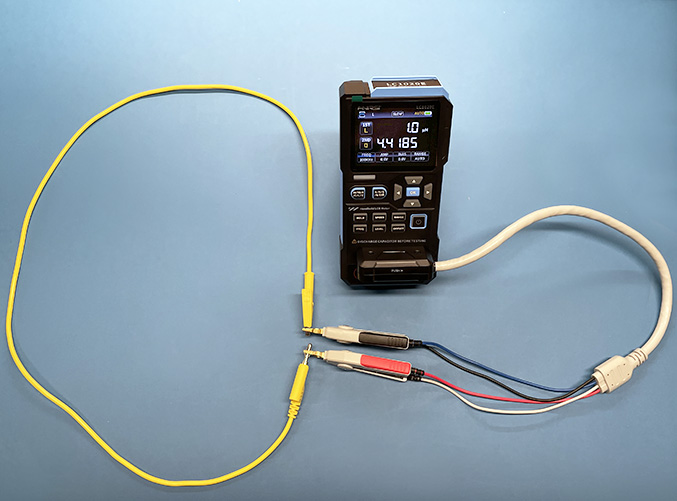
An inexpensive RLC meter can be used to illustrate how loop inductance varies with the size and shape of a wire loop. This can be done as a classroom demonstration or a laboratory exercise.
Preparation: Students need to be able to calibrate and operate an RLC meter.
Equipment Required:
- RLC meter with Kelvin probes
- about 80 cm of #24 wire (length and diameter are approximate)
Procedure:
Step 1: Set the measurement frequency of the RLC meter to its highest value (typically 1 kHz - 100 kHz). With the Kelvin probes attached, perform an open-circuit and short-circuit calibration of the RLC meter.
Step 2: Connect the probes to both ends of the wire and adjust the shape of the wire loop to be approximately circular.
Step 3: Compare the measured inductance to the calculated value of the inductance for a circular loop with the same wire diameter. (Generally, they should agree to one or two significant figures.)
Step 4: Change the shape of the loop to form a rectangle, square, triangle, or any other relatively open shape. Note the relatively minor effect that this has on the measured inductance.
Step 5: Elongate the loop so that it resembles two parallel wires that are shorted on the end. Note the new inductance value. How does the change in the inductance compare to the change in the loop area?
Step 6: Twist the loop so that it resembles a twisted wire pair. Note the new inductance value. What impact did twisting have on the measured inductance? Why is this the expected result?
Step 7: What loop geometry (without changing the length or diameter of the wire) would you expect to yield the smallest measured inductance? Experiment with the loop to determine the configuration with the smallest measurable inductance.
Notes:
The equations for the inductance of a loop are complicated and difficult to solve without a calculator. A key point of this exercise is that estimating the inductance of simple loops can be done with reasonable accuracy even without knowing the exact shape of the loop or the wire diameter.