
Chapter 2 Lab Exercise: Measuring the Absolute Capacitance of an Object
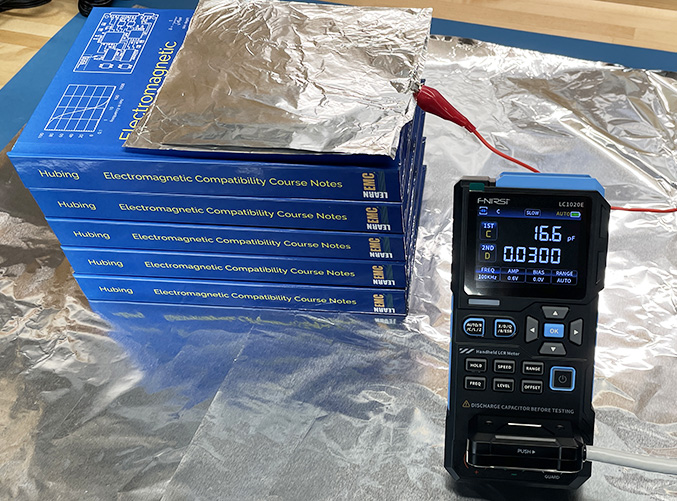
Estimates of the self-capacitance of a bulky metal object (e.g., heatsink or metal chassis) play a key role in modeling various emissions and immunity test configurations. A low-cost RLC meter can be used to illustrate the concepts of absolute capacitance, self-capacitance, and mutual capacitance and demonstrate how these parameters can often be estimated (at least to an order of magnitude). Here, we'll measure the capacitance between a small piece of aluminum foil and something much larger.
Preparation: Students need to be able to calibrate and operate an RLC meter. They should also estimate the absolute capacitance of a 15-cm-square sheet of aluminum foil using the guidance in Chapter 2.
Equipment Required:
- low-cost RLC meter with Kelvin probes
- access to a large metal surface (e.g. a metal desktop or large sheets of aluminum foil)
- small sheet of aluminum foil (approximately 15 cm x 15 cm)
- jumper wire with alligator clips (approximately 50 cm long)
Procedure:
Step 1: Set the RLC meter to measure capacitance at 10 kHz or 100 kHz. Perform calibrations with the Kelvin probes open and shorted. Note the range of values displayed when the probes are open.
Step 2: Connect one of the probes to the large metal surface.
Step 3: Note the capacitance reading. How much has it changed compared to having both probes unconnected?
Step 4: Connect the other Kelvin probe to the small sheet of aluminum foil using the jumper wire. Use a non-conducting object (e.g., a stack of books as shown in the figure) to separate the small foil sheet from the metal surface. Make sure the system is self-supporting and remove your hands. What is the measured value of the capacitance between the foil and the much larger metal object. How does it compare with the estimated value of the small sheet's absolute capacitance?
Step 5: Change the distance between the small sheet and the metal surface (e.g., by adding or removing books). How does the measured value of the capacitance change with distance?
Step 6: At various distances, change the orientation of the small foil sheet. Note how the capacitance changes (or doesn't change with orientation).
Step 7: Fold the small sheet twice so that it is now about 7.5 cm square. Repeat the measurements above. How do the new values of measured capacitance compare to your expectations?
Notes:
If this is done as a classroom demonstration, it is a good idea to ask students what they expect the result to be before each new measurement.