
Chapter 1 Lab Exercise: Ambient Signal and Noise Measurements
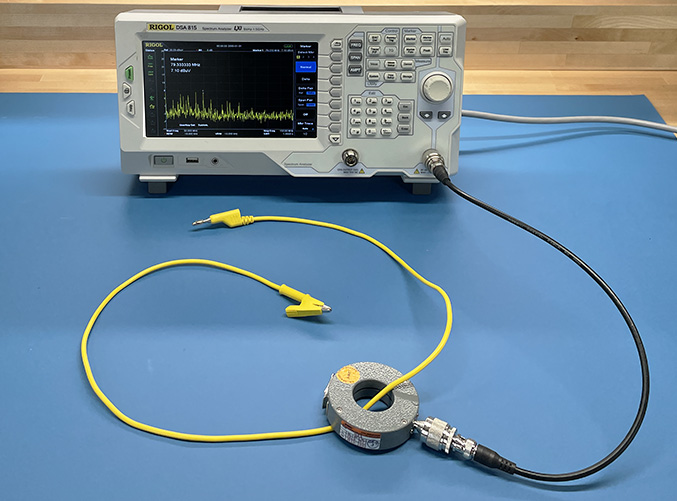
A spectrum analyzer can be used to demonstrate that electromagnetic noise is everywhere. If this exercise is performed as a demonstration, it's helpful to use a spectrum analyzer with an HDMI output that can project on the classroom screen. If students are asked to do this as a laboratory exercise, they can use a spectrum analyzer in the lab or a miniature spectrum analyzer.
Preparation: Students need to know that the spectrum analyzer is measuring voltage as a function of frequency, but the analyzer operation and settings will be covered later in the course. This exercise is a brief introduction to the electromagnetic environment.
Equipment Required:
- spectrum analyzer
- about 80 cm of #12 wire (length and diameter are approximate)
- adapter to connect a wire to the center conductor of the analyzer input
- RF current probe
Procedure:
Step 1: Connect the wire to the center conductor of the spectrum analyzer input. Use an insulated wire and be careful not to damage the input by letting the wire momentarily contact anything that is not well grounded.
Step 2: Set the measurement frequency range to 30 MHz - 200 MHz and reduce the noise floor by setting the resolution bandwidth to 1 kHz.
Step 3: Use the marker to record the highest peaks observed in this frequency range. Can the source of any of these peaks be identified?
Step 4: Power on a digital device near the wire and note any changes in the recorded waveform.
Step 5: Remove the connection between the spectrum analyzer and the wire. Connect the RF current probe to the analyzer and position the probe around the wire near its center.
Step 6: Repeat Steps 3 and 4 and record the peaks in the current induced on the wire.
Step 7: Note how the amplitude of the peaks changes as the current probe is moved closer to the ends of the wire. Do all the peaks disappear when the probe is moved beyond the end of the wire?
Notes:
Depending on the environment, the frequency range of this exercise can be adjusted. In most classroom and laboratory environments, students will see local FM radio stations between 88 MHz and 108 MHz. They may also pick up noise from HVAC, lighting, and communication systems in the building. The length of the wire can be adjusted if necessary to get a better signal-to-noise ratio for the sources in any particular environment.