
Chapter 1 Lab Exercise: Examples of Electromagnetic Interference
These simple demonstrations can be performed in front of the class or assigned as a laboratory exercise. The goal is to provide common examples of electromagnetic interference that students may already have encountered. Students can be asked to identify the source, victim and coupling mechanism. They can also be asked to share their own experiences with similar forms of EMI.
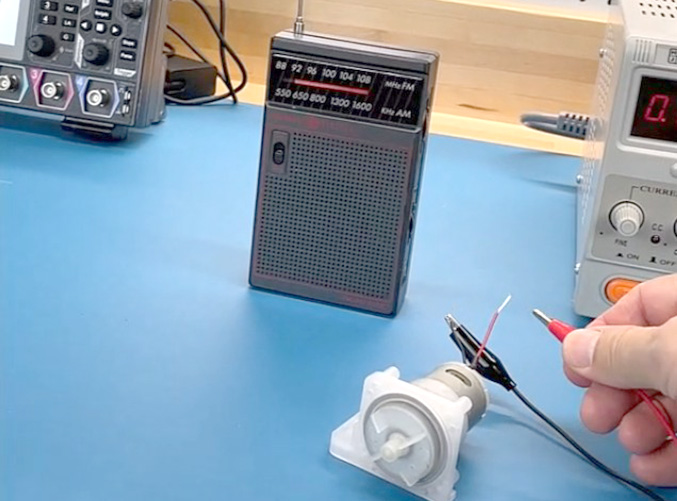
A small, brushed DC motor interfering with a handheld AM radio
Virtually any brushed DC motor creates enough noise to be picked up by a portable AM radio. You can see a brief video demonstration by clicking here or on the image to the left.
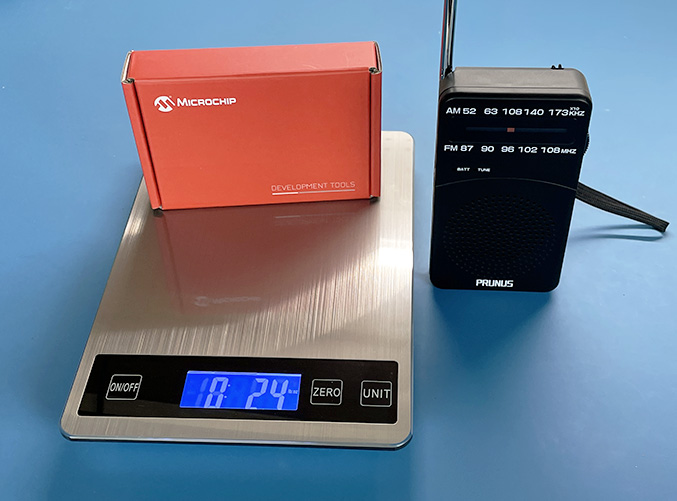
A small digital device interfering with an FM radio tuned to a harmonic of the clock frequency.
Most electronic toys and computing devices emit power in the FM radio band that can be picked up with a nearby portable radio. This is true even when these devices meet federal radiated emissions requirements.
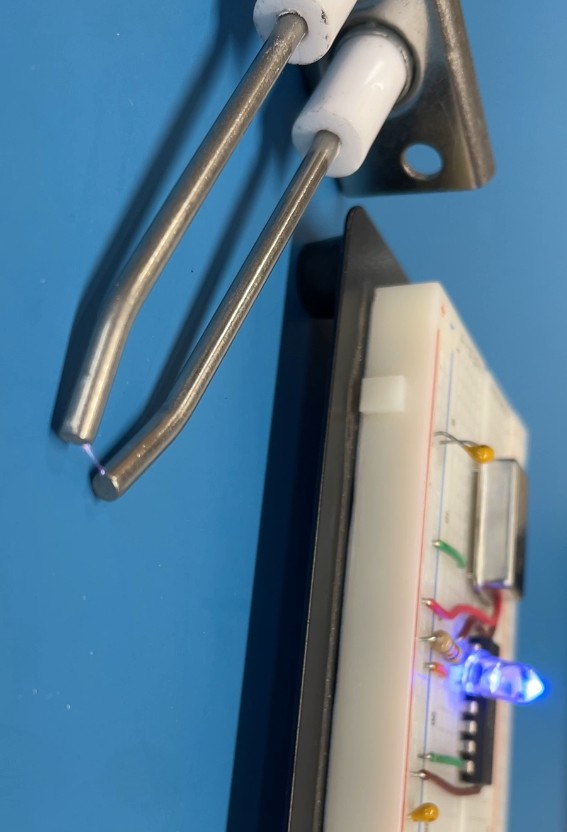
Latch-up caused by electrostatic discharge.
Use an ESD simulator, or a spark generator such as a gas grill ignitor, to create latch-up in an electronic device. An ESD discharge can temporarily disable many inexpensive clock radio displays, scales, and electronic toys. You may have to experiment a bit to find the right device for this demonstration. We suggest that you don't experiment on valuable items, because ESD can permanently damage some devices.
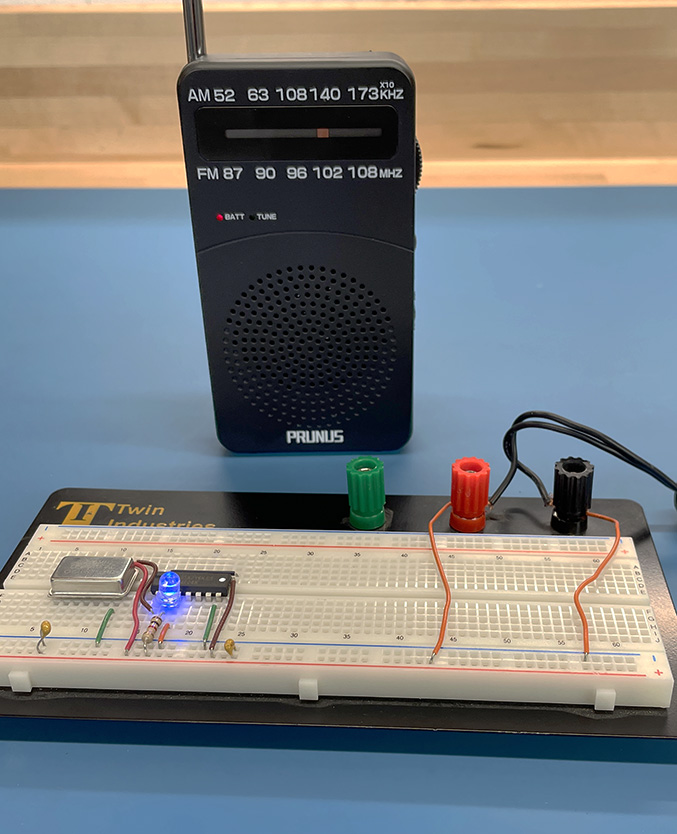
Demonstration of intentional EMI.
Use an RF signal generator, or a simple circuit that generates a digital clock, to produce noise that drives two conductors relative to each other. Choose the frequency of the driving signal so that the fundamental or one of its harmonics falls on a frequency that is shared by an FM radio station in your area. Demonstrate that the radio station goes silent when the interfering signal is present.