
EMC Question of the Week: May 29, 2017
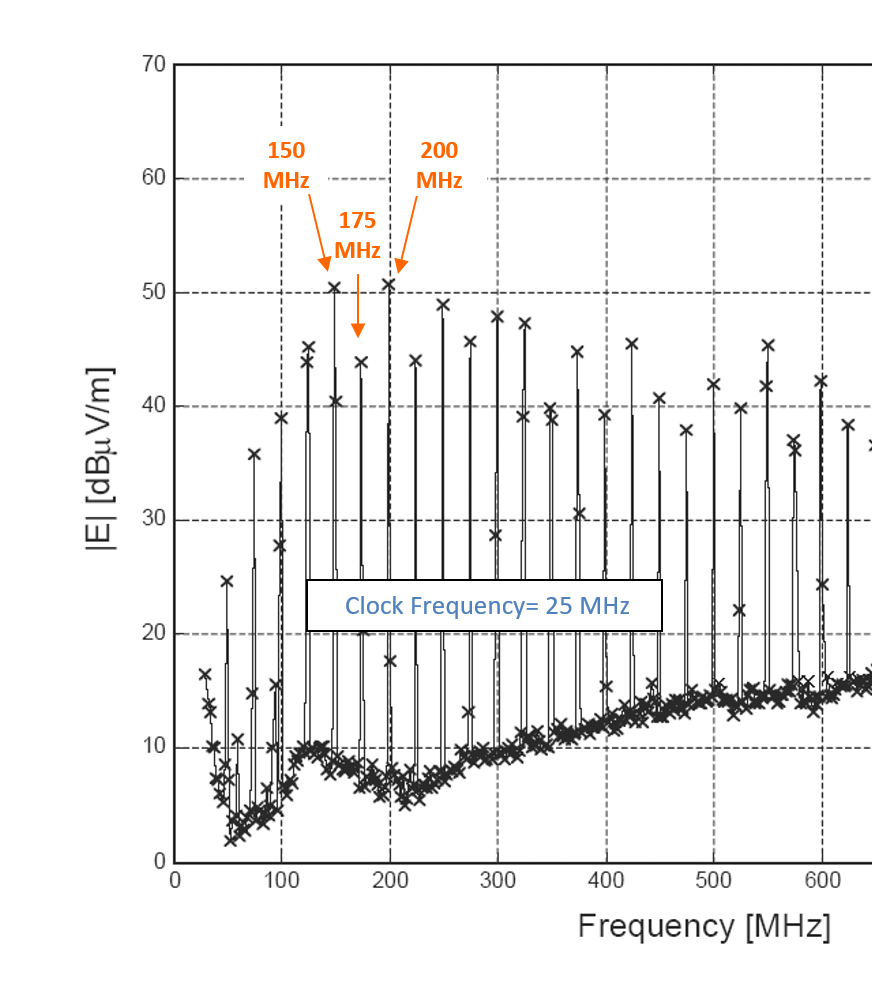 In a radiated emissions test, if the even harmonics of a digital clock frequency are higher than the odd harmonics, the primary noise source is likely to be,
- clock nets
- data nets
- cables
- power bus noise
Answer
The correct answer is "d". Narrow band components of the power bus noise on a circuit board typically have fundamental frequencies that are twice the clock frequency. This is because the current draw from the power bus has the same polarity on low-to-high transitions as it does on high-to-low transitions. One period of the time-domain clock signal involves at least two transitions with different polarities, whereas the corresponding power bus current will exhibit two transitions with the same polarity. This will typically resemble a periodic signal with half the clock period (or twice the clock frequency).
Radiated emissions due to the clock signal itself will generally exhibit odd harmonics that are higher than the even harmonics. This is especially true for the lower harmonics (i.e. the first ~15 harmonics). Radiated emissions due to data signals will be highly dependent on the data. They may resemble the clock signal emissions, or they may be more broadband; perhaps with no discernable harmonic content.
The cables are likely to play an important role in radiated emissions, particularly below 100 MHz. However, there is nothing inherent in radiated emissions from cables that is likely to result in the even harmonics being radiated more efficiently than the odd harmonics.
Have a comment or question regarding this solution? We'd like to hear from you. Email us at