
Last Week's Question
If the measured radiated emission at a particular frequency is 45 dB(μV/m) and the limit is 40 dB(μV/m), then the product is over the limit by,
- 5 dB
- 5 dB(μV/m)
- 13%
- a factor of 2
Answer
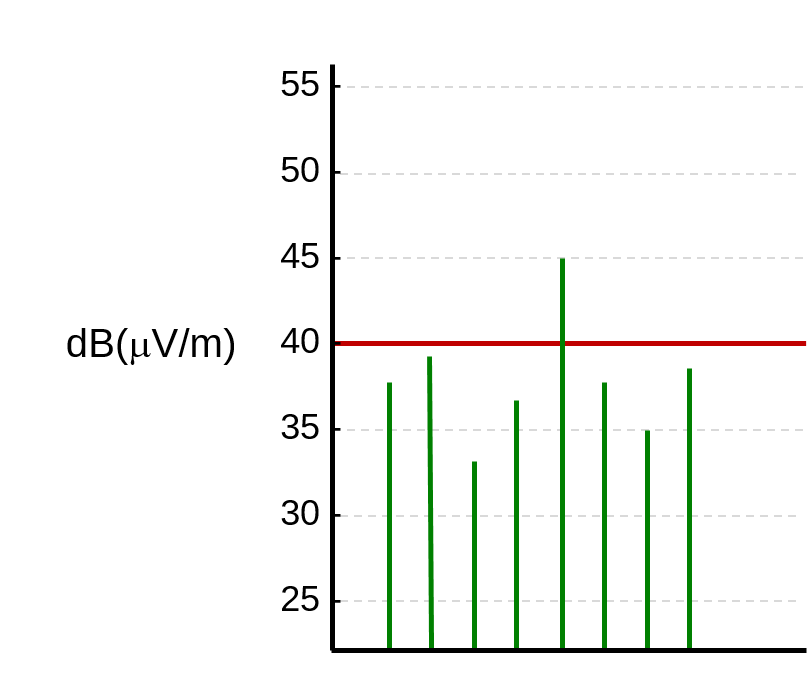 The correct answer is "a". The simple fact is, 45 dB(μV/m) - 40 dB(μV/m) = 5 dB. 45 dB(μV/m) describes an electric field intensity that is 45 dB above 1 μV/m. 45 dB represents a field intensity ratio of about 178, therefore 45 dB(μV/m) is equivalent to approximately 178 μV/m. 40 dB(μV/m) is 100 μV/m. The product is over the limit by a factor of 178/100. Expressed in dB, this is 20*log(178/100) = 5 dB.
It is NOT correct to say the product is 5 dB(μV/m) over the limit. 5 dB(μV/m) is a field intensity, not a ratio. In fact, 5 dB(μV/m) corresponds to a field intensity of about 1.78 μV/m, which has nothing to do with the product's emissions or the limit.
13% is also clearly incorrect. If we wanted to express the relationship between the product emissions and the limit as a percentage, we might choose to say that the electric field intensity exceeds the limit by 78%. This can be confusing though. We have to make it clear that we are referring to the ratio of the field intensity and not the ratio of the power density. Also, while the emissions exceed the limit by 78%, the limit falls short of the emissions by 1 - 100/178 or 44%. Expressing ratios of electrical signal quantities in dB eliminates any confusion related to which quantity was the reference and whether we are referring to the signal amplitude or signal power.
"a factor of 2" is also incorrect. Had the emissions been 6 dB over the limit, we could have said that the field strength exceeded the limit by a factor of 2 (or that the power density exceeded the limit by a factor of 4). When discussing ratios of electrical signal quantities (e.g. amplifier gain, cable attenuation, signal-to-noise ratios, model-measurement comparisons, etc.) it is generally much clearer and more concise to express these ratios in dB.
Have a comment or question regarding this solution? We'd like to hear from you. Email us at