
Last Week's Question
Choose the best answer: The inductance of a loop of wire wrapped once around your wrist is,
- a few hundred nanohenries
- anywhere from a few nH to a few henries
- proportional to loop area
- proportional to wrist diameter
Answer
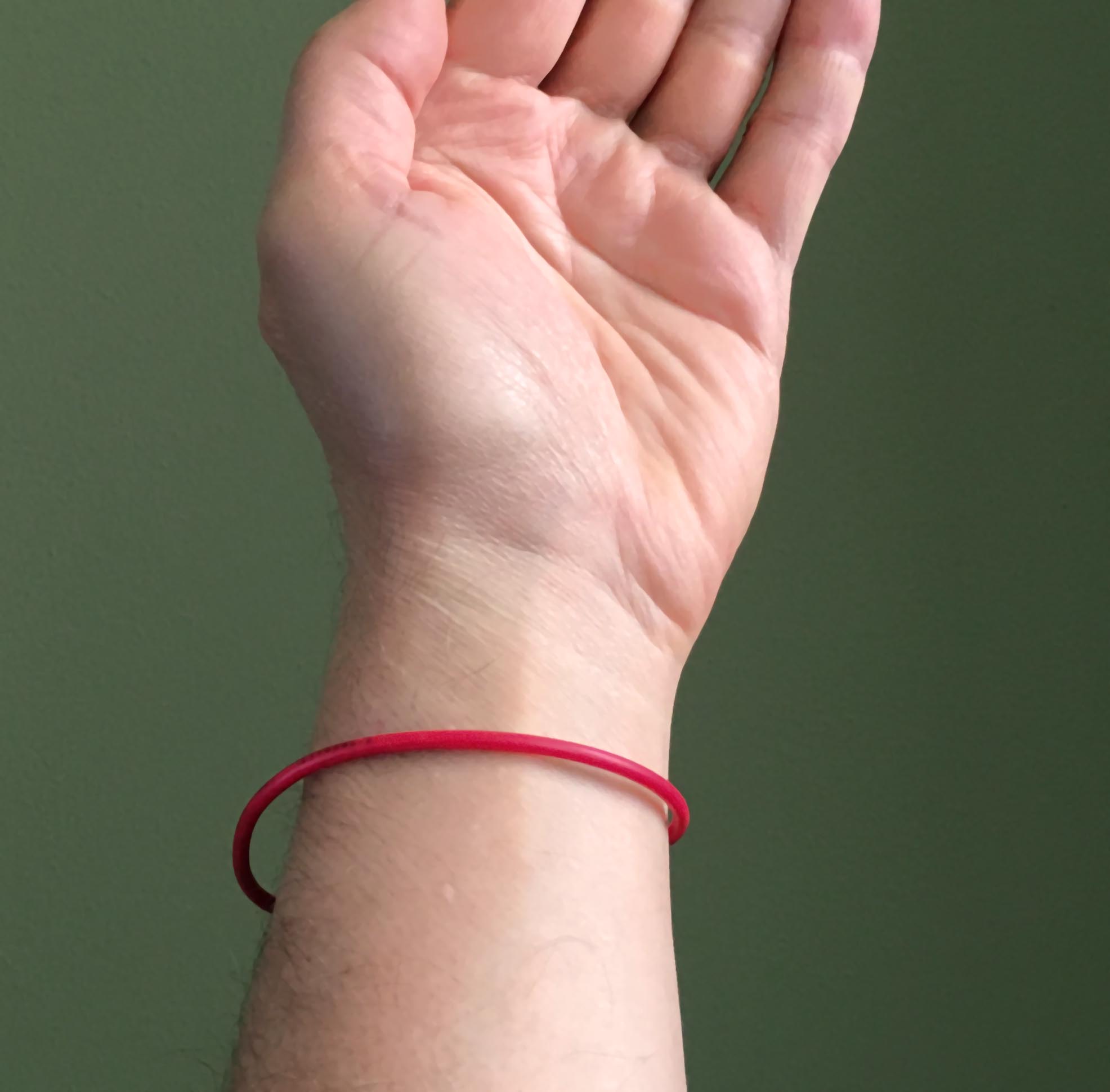 If you've been working in EMC for any
length of time, you've probably heard that the correct answer to every EMC question is "It depends."
That may be true, but "it depends" is not a particularly helpful answer. Better answers are generally those
that convey useful information.
If you've been working in EMC for any
length of time, you've probably heard that the correct answer to every EMC question is "It depends."
That may be true, but "it depends" is not a particularly helpful answer. Better answers are generally those
that convey useful information.
The best answer to the question above is "a". Of course "best" is a subjective term, so let's examine each of the possible answers starting with the last choice and working our way up.
Choice "d": The external inductance of a circular loop of wire is given by the equation, Lcircle ≈ Rμ[ln(8R/a)−2.0] where "R" is the loop radius and "a" is the wire radius. This expression is proportional to the loop radius times the natural log of the loop radius. In order to be proportional to the loop diameter, it would have to be proportional to the loop radius. So strictly speaking, choice "d" is not correct. Nevertheless, circular loops with larger diameters will tend to have larger inductances, which is a point worth keeping in mind.
Choice "c": It's not uncommon to hear people say that inductance is proportional to loop area. But, as we just pointed out, the external inductance of a circular loop is proportional to the loop radius times the natural log of the loop radius. The loop area is proportional to the radius squared. So inductance is no more proportional to loop area than it is to loop diameter or loop circumference.
Choice "b": This choice offers a range of possible values for the inductance. For EMC work, knowing the range of possible values is often more useful than just knowing how to calculate something. How does this range of values compare to the possible inductance that a loop of wire around your wrist might have? On the low side, suppose we assume a very tiny wrist (R = 2 cm) and a fat wire (a = 5 mm). In this case the calculated inductance would be about 36 nH. It's hard to imagine how we might get a value of a few nH without using a wide strap that no longer resembled a wire. On the high side, we can get any arbitrarily high value of inductance that we want by simply making the wire radius smaller and smaller. In the limit as the wire radius approaches zero, the inductance approaches infinity. So an argument can be made that choice "b" is as accurate (or as inaccurate) as choices "c" and "d". It's not strictly correct, but conveys some information.
Choice "a": Let's calculate the inductance of a typical wire (24 gauge, a = 0.255 mm) wrapped around a typical wrist (R = 3.5 cm). In this case, we get L = 220 nH. Make the wrist small (R = 3 cm) and the wire thick (12 gauge, a = 1.026 mm) and we get, L = 130 nH. Make the wrist bigger (R = 4 cm) and the wire thinner (32 gauge, a = 0.101 mm), gets us as high as L = 304 nH. Wrist size and wire diameter can take on different values, so it would not be correct to answer this question with a precise value for the inductance. However for reasonably sized wrists and wires, the inductance can be estimated to be a "few hundred nanohenries". Is this always strictly true? No. None of the choices are always strictly true. But unlike the other three choices, "a" provides a reasonable estimate.
Have a comment or question regarding this solution? We'd like to hear from you. Email us at