
EMC Question of the Week: October 21, 2019
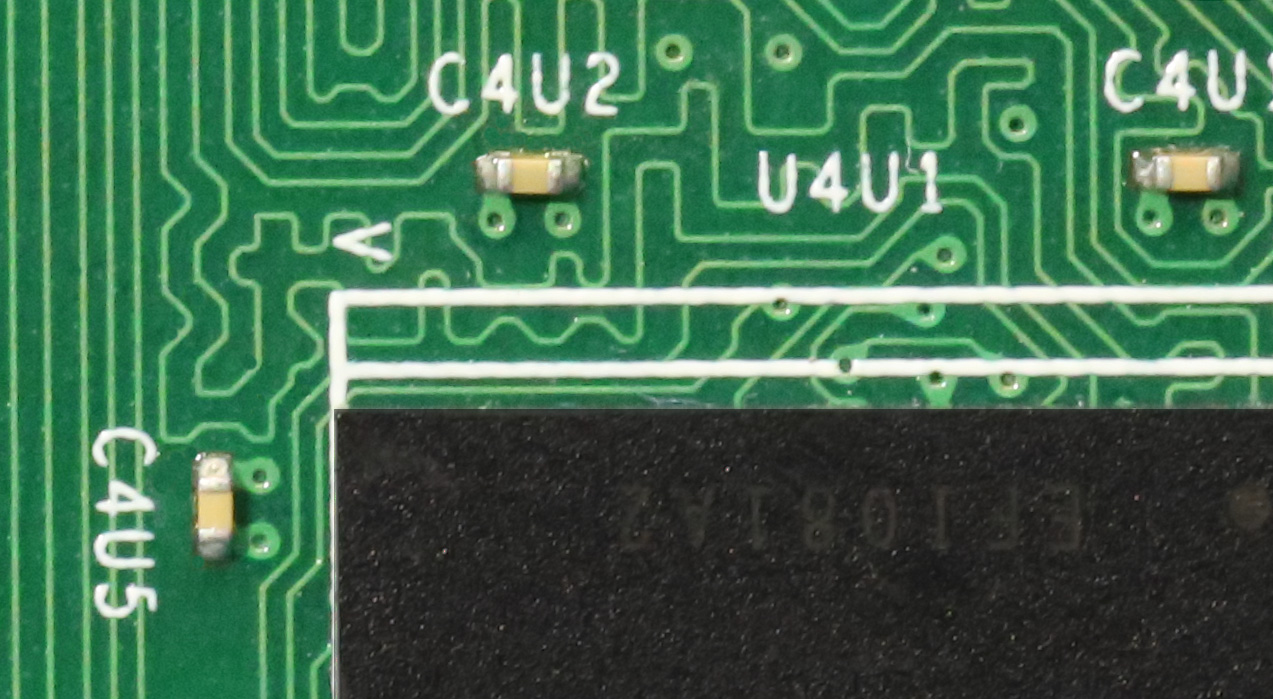
On boards with closely spaced (<0.3 mm) power and ground planes,
- decoupling capacitors should share vias with the power and ground pins of active devices
- decoupling capacitors should be located between the power and ground pins of active devices
- the precise location of decoupling capacitors is not critical
- decoupling capacitors are not required
Answer
The best answer is "c". Generally, on boards with closely spaced power and ground planes, all of the decoupling capacitors are "global" (i.e. they respond to changes in the power plane voltage and do not serve a specific device). In this case, it is good to distribute them around the board with a sufficient number in the general vicinity of the devices that draw the most current from the planes. The exact location of each capacitor is not critical and there is no advantage to sharing vias with the active devices. In fact, attempting to share vias generally increases the connection inductance of the capacitor and/or the active device with undesirable consequences.
Some EMC white papers and texts suggest that decoupling capacitors need to be within a few millimeters of the active device in order to account for the propagation delay between the device and capacitor vias. This is an unfortunate myth. Even well-mounted decoupling capacitors have at least a nanohenry of connection inductance. The amount of charge they are capable of supplying in the first 500 picoseconds after a dip in the power bus voltage is insignificant compared to the charge supplied by the plane capacitance. All decoupling capacitors mounted within several centimeters of an active device provide roughly the same amount of charge, no matter how quickly the device tries to draw it.
Of course, it is dangerous to rely on simple rules for decoupling without understanding the physics behind them. There are certain situations where the location of a decoupling capacitor could be important on a board with closely spaced planes; though in these situations, being closer to the active device is not necessarily better.
When the power and ground planes are not closely spaced, it is best to rely on "local" decoupling capacitors. In this case, the location is extremely important. For more information check out the Circuit Board Decoupling Information on this website.
Have a comment or question regarding this solution? We'd like to hear from you. Email us at