
EMC Question of the Week: September 23, 2019
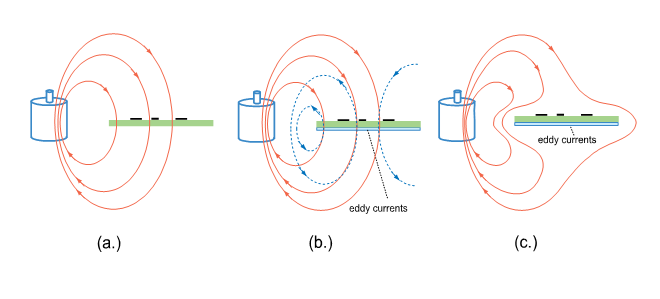
At frequencies above a few hundred kilohertz, magnetic fields can’t penetrate a solid copper layer in a printed circuit board due to
- the high permeability of copper
- the high permittivity of copper
- eddy currents
- the Coriolis effect
Answer
The correct answer is "c". When a magnetic flux passes through a conductor, it induces circulating currents called eddy currents. The magnetic flux produced by the eddy currents opposes the originating flux. In good conductors at high frequencies, the opposing flux is nearly equal to the originating flux and virtually no flux passes through the conductor.
The first choice is not correct, because copper does not have a high permeability. It has approximately the same permeability as free space. The second choice is not correct, because copper is a good conductor and doesn't have a quantifiable permittivity. The fourth choice is not correct, because the Coriolis effect has nothing to do with magnetic fields or currents.
It's tempting to say that it is the skin depth of copper that keeps magnetic fields from penetrating a flat sheet at high frequencies; however skin depth describes the penetration of normal and tangential EM plane waves into a flat conducting interface. Eddy currents, on the other hand, can be calculated for any arbitrary incident magnetic field and interface geometry. Gaps or discontinuities that interrupt the flow of eddy currents can allow magnetic fields to easily penetrate copper plates that are several skin depths thick.
Have a comment or question regarding this solution? We'd like to hear from you. Email us at