
EMC Question of the Week: August 19, 2019
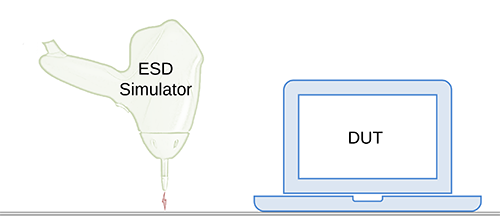
Generally, if an indirect ESD test toggles the reset input on a microcontroller, the reset input trace needs
- to be rerouted
- a TVS diode
- a capacitor
- a series resistor
Answer
The best answer is "d". Indirect ESD events should never toggle a low-speed digital input. Field-coupled ESD transients generally have durations less than a few nanoseconds and they have very little energy. The transition times of critical low-speed digital inputs should always be controlled (usually with a series resistor). If the reset input of a microcontroller has a well-positioned 1-kΩ series resistor, it will not be toggled by indirect ESD.
The other options listed may or may not work, depending on the situation. Rerouting the trace could be difficult, because fields from the indirect ESD event are nearly everywhere. Burying the trace between planes may help, but this option is usually more difficult and not guaranteed to work. TVS diodes work well for blocking the low-frequency, higher-energy components of a direct discharge, but not the higher-frequency components that are prevalent in a field-coupled discharge. Shunt capacitors are also generally ineffective for blocking high-frequency components of a discharge due to their connection inductance.
Have a comment or question regarding this solution? We'd like to hear from you. Email us at