
EMC Question of the Week: May 27, 2019
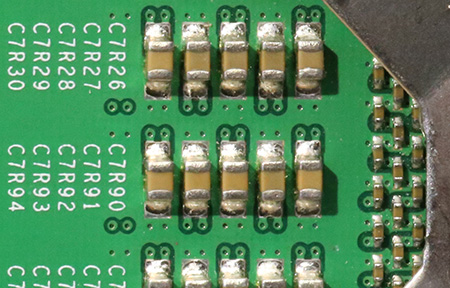
X7R multi-layer ceramic capacitors are often used to provide high-frequency decoupling on printed circuit boards because,
- their value is independent of applied voltage
- their value is independent of temperature
- they have more capacitance per volume than tantalum capacitors
- they have more capacitance per volume than NP0 capacitors
Answer
The best answer is "d". X7R capacitors are Class 2 ceramic capacitors. Compared to Class 1 ceramic capacitors (like NP0s), their value is not particularly stable with temperature or applied voltage. The greatest advantage that Class 2 capacitors have over Class 1 capacitors is the ability to achieve relatively high values of capacitance in a small package size.
In printed circuit board decoupling applications, the exact value of the capacitance is not a major concern. In addition, there is always a significant DC bias across the capacitor that minimizes variations in capacitance due to changes in the applied voltage.
Tantalum capacitors, which are electrolytic capacitors, generally have a higher capacitance per volume than ceramic capacitors. They are often used to provide low-frequency decoupling on circuit boards, but not for high-frequency decoupling. At high frequencies, where connection inductance becomes more important than nominal capacitance, multilayer ceramic capacitors are a much more cost-effective alternative.
Have a comment or question regarding this solution? We'd like to hear from you. Email us at