
EMC Question of the Week: May 6, 2019
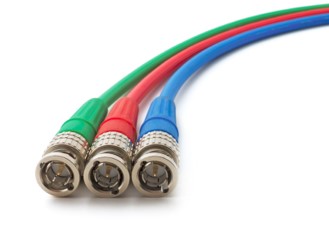
If a 50-Ω coaxial cable has an attenuation due to conductor loss of 12 dB/km at 1 MHz, the attenuation due to conductor loss at 10 MHz is likely to be about
- 12 dB/km
- 15 dB/km
- 22 dB/km
- 38 dB/km
Answer
The best answer is "d." While both dielectric and conductor losses contribute to cable attenuation, the conductor losses tend to dominate in most realistic cable geometries at frequencies well below 1 GHz. At 1 MHz, the skin depth of copper is about 65 μm. Realistic cable geometries have conductor thicknesses much greater than this, so the resistance of the conductors is inversely proportional to the skin depth; or proportional to the square root of the frequency. The attenuation due to conductor loss in dB per meter is,
where α is the attenuation constant, which is proportional to the resistance per unit length in low-loss cables.
In this example, increasing the frequency by a factor of 10 increases the resistance per unit length by approximately 3.16 (square root of 10). The attenuation in dB/km is therefore increased by a factor of 3.16; or 12 dB/km x 3.16 = 38 dB/km.
Of course, this is just an estimate of the overall cable attenuation. Dielectric losses, on average, also tend to increase with frequency. If a precise value is required, it's best to consult the specifications for the specific cable. Cable loss is generally specified at many different frequencies corresponding to the useful bandwidth of a particular cable.
Have a comment or question regarding this solution? We'd like to hear from you. Email us at