
EMC Question of the Week: April 2, 2019
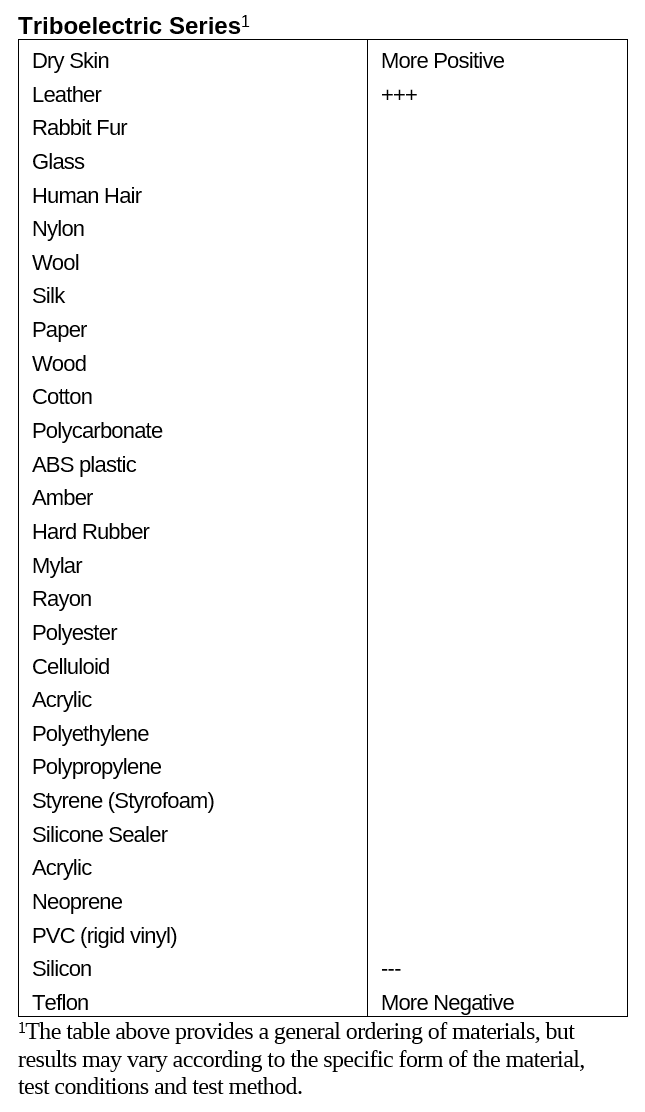
A triboelectric series ranks materials based on
- conductivity
- affinity for moisture
- shielding effectiveness
- affinity for electrons
Answer
The correct answer is "d." When two dissimilar materials are in contact, electrons can be shared at the boundary. These electrons will statistically spend more time on the side of the boundary with the material that is lower on the triboelectric series chart.
When both materials are good conductors and they are separated, the electron balance is restored. However, electrons move more slowly on good insulators. When both materials are insulators, suddenly separating them can result in excess electrons becoming trapped on one material (with a corresponding lack of electrons on the other material). The excess electrons, no longer tied to the boundary, redistribute themselves. When the materials make contact and separate again, the process is repeated until eventually the objects attached to each material become charged to a voltage that prevents further charge separation. Generally, that voltage will be higher for materials that are further apart in the triboelectric series.
The voltages that result in electrostatic discharges (and lightning) are the result of this type of charge separation. One technique for preventing electrostatic discharge is to identify the materials responsible for the charge separation and replace them. Another technique is to chemically treat the materials in order to increase their conductivity.
Have a comment or question regarding this solution? We'd like to hear from you. Email us at