
EMC Question of the Week: February 11, 2019
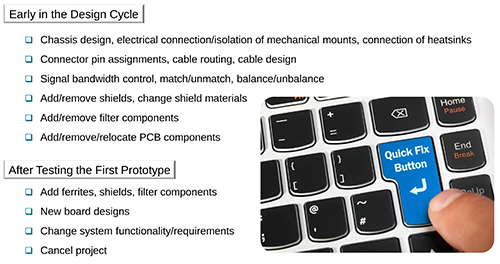
EMC issues are most effectively addressed
- before the first hardware has been built
- after the first prototypes are available, but before testing
- after the first prototypes have been tested
- once the hardware design is stable
Answer
The best answer is "a." Before the first hardware has been built, it is relatively easy to ensure that component placement is optimum, traces are routed properly, transition times are controlled, decoupling is adequate, etc. However, once the first prototype has been built, it is often too late to correct simple design errors that result in EMC problems. Important decisions regarding component selection and placement, connector pin assignments, signaling strategies, grounding, filtering and shielding are often locked-in by the time prototype testing has begun. Even worse, EMC test results on prototype hardware are often used to justify poor design decisions. This can result in serious and costly-to-fix EMC problems that appear in the final verification stages (or even after shipping the product).
Building a prototype and then fixing EMC problems as they arise during testing, is sometimes referred to as design-test-fix. This approach is not only costly, it can be dangerous as well. EMC tests are designed to validate good designs and flag possible problems. They cannot simulate every possible interference situation that might arise in real applications. Tweaking a design to pass a specific test in a specific test lab does not ensure that problems won't occur in the field. Some design changes performed in order to pass a given test, can actually make a product more vulnerable to electromagnetic interference in the field. Well-designed products will meet their EMC requirements the first time they are tested. It shouldn't make any difference which test lab was used or how the product was configured for a specific test.
Have a comment or question regarding this solution? We'd like to hear from you. Email us at