
EMC Question of the Week: November 5, 2018
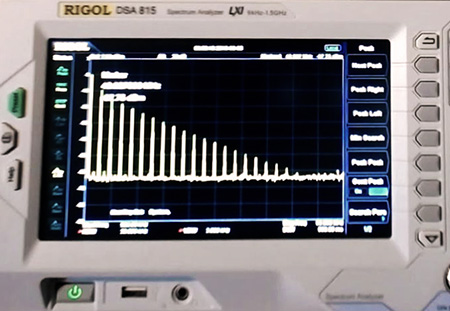
If the amplitude of a periodic time-domain signal is doubled, the amplitude of its harmonics in the frequency domain
- remains the same
- increases by 40%
- doubles
- quadruples
Answer
The correct answer is "c". The conversion from time domain to frequency domain is linear. Multiplying a time-domain signal by any constant will result in its frequency-domain representation being multiplied by the same constant. Likewise, two time-domain signals summed together will have a frequency-domain representation that is the sum of the two original frequency-domain signal representations. (Of course, we must account for both the magnitude and phase in the frequency domain.)
If you chose d (i.e. quadruples), you may have been thinking of the power spectrum. We generally represent signals in the time domain by their voltage, then we talk about the power in the harmonics. It's important to be clear about whether we mean voltage or power when we talk about a signal "doubling" or "increasing by x%". That's the main reason EMC and signal integrity engineers like to work with decibels. The same options in the problem above expressed in decibels would have been:
- 0 dB
- 3 dB
- 6 dB
- 12 dB
Expressed this way, it doesn't matter whether we're talking about voltage or power, the meaning is clear. Most EMC and signal integrity engineers would readily identify c (6 dB) as the correct answer.
Have a comment or question regarding this solution? We'd like to hear from you. Email us at