![]() EMC Question of the Week: October 29, 2018
EMC Question of the Week: October 29, 2018
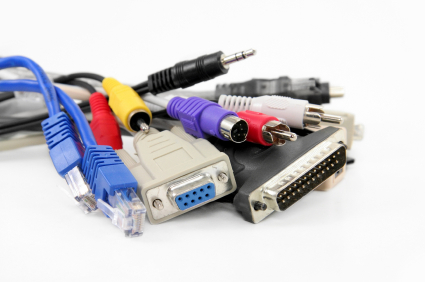
Which of the following signal interfaces employ single-ended signaling?
- Ethernet (e.g. 10BASE-T)
- CAN and LVDS
- USB, DVI-D and HDMI
- RS-232, VGA and SCSI
Answer
The correct answer is "d". RS-232, VGA and SCSI are single-ended interfaces that convey information as a voltage relative to ground. Single-ended interfaces have the advantage of being able to convey multiple independent signals in parallel that share a ground or current-return conductor. So N signals can be conveyed on as few as N+1 wires without any multiplexing or special encoding.
All of the other digital interfaces listed employ differential or pseudo-differential signaling. These interfaces require two dedicated conductors for each signal. Due to their balanced construction, differential interfaces often exhibit better electromagnetic immunity.
Truly differential interfaces, such as most implementations of Ethernet, exhibit relatively low radiated emissions because differential signals are relatively inefficient sources of EM radiation. On the other hand, most pseudo-differential signal drivers (e.g. most drivers used in CAN, LVDS, USB, DVI-D and HDMI) drive the conductors with a significant, unintentional common-mode voltage. For this reason, EMC engineers need to pay close attention to the common-mode current-return path when designing products that employ high-speed pseudo-differential signals.
Have a comment or question regarding this solution? We'd like to hear from you. Email us at