
![]() EMC Question of the Week: September 24, 2018
EMC Question of the Week: September 24, 2018
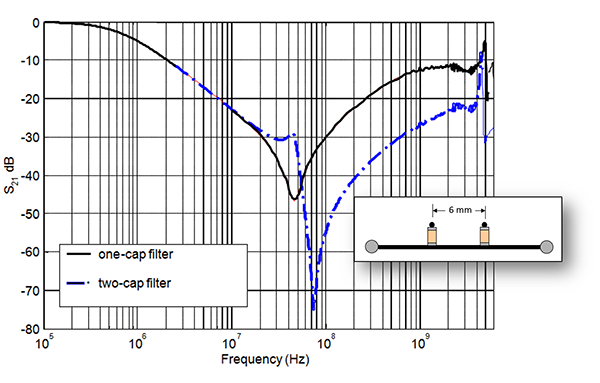
A good low-pass filter on a circuit board trace might consist of two shunt capacitors that
- have approximately the same value and some space between them
- have approximately the same value and share the same connection points
- have values that differ by two orders of magnitude and are separated by 1 cm
- have values that differ by two orders of magnitude and share connection points
Answer
The best answer is "a". It's true that this question includes the word "might," which makes almost any answer possibly correct. Nevertheless, the first answer describes most well-designed two-capacitor low-pass filters on printed circuit board traces. Using approximately the same values for both capacitors minimizes the chances that a significant parallel resonance will develop. Providing some space between the capacitors minimizes their mutual inductance and effectively forms a pi-filter where the trace between the capacitors serves as the inductor.
If both capacitors share the same connection points, their mutual inductance will be larger than it needs to be. This will increase the overall connection inductance and limit the high-frequency performance of the filter. If the two capacitors are connected in parallel and one of them has a value much different than the other one, a parallel resonance will occur at a frequency where the larger valued capacitor has gone self-resonant and the smaller valued capacitor hasn't. This resonance can be particularly strong when the difference in the capacitor values is an order of magnitude or more.
Although there are exceptions to every rule, it is generally not a good idea to connect a large valued capacitor and a small valued capacitor in parallel along a circuit board trace. In rare circumstances where this is necessary, it is often a good idea to ensure that there is sufficient resistance in series with the larger valued capacitor to prevent a significant parallel resonance from developing.
Have a comment or question regarding this solution? We'd like to hear from you. Email us at