
Yes, the Energy is in the Spaces, not the Traces. But!
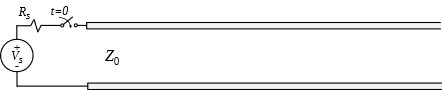
Suppose we have a uniform transmission line with an air dielectric. There is a source at one end that connects to the transmission line through a switch that closes at t=0. How fast does the current move down a uniform transmission line with an air dielectric?
The correct answer is at or near the speed of light. The voltage difference between the two conductors also propagates at the same speed. The voltage and the current in a uniform transmission line satisfy the wave equations.
.
These equations were derived by Oliver Heaviside in the late 1800s and applied to telegraph communications. These equations tell us that the velocity of propagation in the transmission line is . In a uniform transmission line, the product LC is always equal to the product με, so . In an air dielectric, this is approximately equal to the speed of light.
Of course, the voltage is proportional to the electric field strength between the conductors, so there is also an electric field that propagates with the same velocity. There is a magnetic field that encircles the currents on each of the two conductors, so there is also a propagating magnetic field. For a given conductor cross-section, the electric and magnetic fields can be determined from the voltages and currents. These fields are always perpendicular to each other and to the direction of propagation.
The magnitude of the power carried by the wave at any location along the transmission line is the product of the voltage and the current at that location. This is equal to the product of the electric field and the magnetic field magnitudes integrated over every point in the transmission line cross-section at that location.
By definition, the power is the rate of energy transfer. Current is the rate of charge flow. Neither of these quantities satisfies the wave equation. Neither of them propagates at the wave velocity.
I find it troubling when people refer to energy moving at the wave velocity, or when people cite the drift velocity of electrons as if that were a particularly meaningful or relevant number.
Which brings me to the point of this blog. As Ralph Morrison was fond of saying, “the energy is in the spaces, not the traces.” For signals propagating on circuit board traces, this is absolutely correct. This is not a new concept. It has been well understood for at least 150 years. It is what I was taught in school many decades ago and is still taught in university transmission line courses today.
There are a number of EMC instructors that I have a great deal of respect for who like to emphasize the idea that the energy is in the spaces. I’ve had difficulty understanding how this helps people design better boards, but I can agree with the following justifications:
- For digital circuit designers and people who have never had a transmission line course, it is a reminder that the current going out is accompanied by an equal amount of current coming back, and that the path of both currents is equally important.
- For circuit designers in general, it is a reminder that there are fields associated with currents, and that guiding or containing these fields can be important.
So, yes. Pointing out that the signal energy is carried in the fields can be helpful. On the other hand, this concept can be (and often is) taken too far. For example, the fields are not more important than the current, and the fields don’t pull the current down the line. The currents and fields coexist, bound by the laws of physics (i.e., Maxwell’s equations). Problems can generally be formulated and analyzed in terms of either quantity depending on which is more convenient. Also, fields can propagate on any number of conductors from zero upward. And the fields that are the greatest contributors to unwanted EMI are often not propagating at all.
Focusing on the fields can be helpful in some situations (e.g., for high-speed signals on electrically long transmission lines). On the other hand, it’s usually much better to focus on the voltages and currents at low frequencies where the currents take the path of least resistance. I believe it’s also better to think in terms of voltages and currents for high-frequency signals when the path is electrically short.
Of course, field coupling plays a crucial role in any EMC design analysis. There are electric fields between any two conductors at different voltages. There are magnetic fields encircling any conductor that carries a current. It's important to anticipate how these fields may couple power in unintended ways, and to recognize that the fields do not have to be propagating to present a problem.
In my experience, very few EMC problems are the result of “losing field containment” in a guided wave. Most EMC problems result from poor grounding, unanticipated current paths, near-field coupling, and other issues that have nothing to do with guiding high-speed signals down a uniform transmission line. In fact, I've witnessed several instances of reviewers who completely missed major design errors while zeroing in on minor disruptions in the path of the signal propagation.
Is the energy in an electrical signal in the spaces? Yes, it is. Is the drift velocity of electrons on the order of millimeters per second? Yes again. How important are these facts when it comes to designing products that meet their EMC requirements? You can decide for yourself, but personally, I think you’re better off focusing your attention on other matters.