
One Step Forward, Two Steps Back
At the 2026 IEEE EMC Symposium in Dallas a few weeks ago, I gave two presentations that started by asking ChatGPT and Claude questions about designing a particular electronic device to meet its EMC requirements. In both cases, the advice received from the AI tools was horrible. In both cases, following the AI advice would have resulted in a really bad, noncompliant design.
Yes, the state-of-the-art in AI is advancing quickly. I've been asking these tools similar questions for 3 years now. The answers are getting more detailed and more consistent, but they are not getting better. The tools are not the problem. The problem is the information sources that these tools rely on. And this is not just a problem for AI tools; it's a big problem for young engineers trying to learn how to design EMC-compliant products.
Both Claude and ChatGPT are very good at citing their sources of information when you ask them to. When Claude confidently told me to establish a single-point ground on the main circuit board of an automotive steering control module (a really bad idea), it cited a couple of vendor application notes and a LinkedIn article as its sources. For those of you who are new to EMC, let's be clear.
Most of the EMC design information in vendor application notes and virtually all of the EMC design advice on LinkedIn is wrong!
If your goal is to become an EMC influencer on social media, then by all means, gather all the information you can from LinkedIn. Post and repost application notes. Use AI to generate posts touting single-point grounds, the 3W rule, the 20-H rule, and other decades-old design myths. LinkedIn rewards people who post often. There is no reward for being accurate. Be surprising. Be controversial. Create posts that draw lots of comments. If someone dares to point out that you are wrong, block them! Blocking somebody removes their negative comment so that everyone else sees only good comments. Blocking also keeps fact-checkers from seeing anything you post in the future.
It's not just LinkedIn. This is the way virtually all social media is structured. Bad information that fits a narrative is widely distributed. Uncomfortable or boring facts don't go very far. Bad information repeated often enough becomes indistinguishable from fact in the minds of social media addicts. LinkedIn, in particular, has become a breeding ground for bad EMC advice.
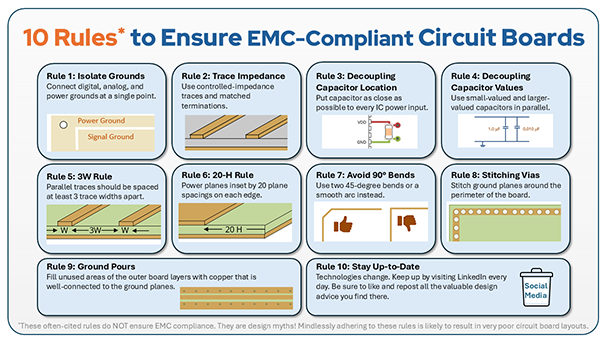
I've started a collection of horrible EMC advice I see posted on LinkedIn. I check in daily to add new items to my collection. It's interesting to see just how bad the advice can get. It's also amazing how many "likes" and "reposts" some of the worst advice can get. One of my favorite posts in the collection is an AI-generated post titled Signal Ground vs Power Ground. It shows a 4-layer board with an ambiguous layout and nonsensical design advice. By the time I added it to my collection, it had gathered 125 likes and 10 reposts!
Anyone can become an EMC influencer on LinkedIn. You don't have to know what you're talking about. You just need to be creative. Of course, you'll get stiff competition from the PCB manufacturers. About 75% of the material in my collection is posted by companies that make printed circuit boards.
If your goal is to learn to design circuit boards and products that meet EMC requirements, I recommend that you limit the time you spend on LinkedIn. LinkedIn is good for learning about upcoming EMC conferences, courses, and webinars. It's good for networking with people who have job responsibilities similar to yours. But you should be highly skeptical of any EMC design advice you find there. Most of it is vague (e.g., pay attention to grounding). The advice that is not vague is almost always wrong.
If you're designing a product that needs to meet EMC requirements and you have an EMC-related design question, don't ask an AI chatbot! Find somebody you can trust, preferably somebody with a proven track record who is willing to guarantee compliance. Good EMC design is not that hard, but it can't be boiled down to a set of simple design rules.