Conductance
The term conductance can refer to any inverse resistance, G=1/R. However, it is generally applied to imperfect dielectrics in the same way that resistance is used to describe imperfect conductors. It is the ratio of the conduction current flowing in the dielectric between two conductors to the potential difference between those conductors.
Example 1: Conductance per Unit Length of a Coaxial Cable
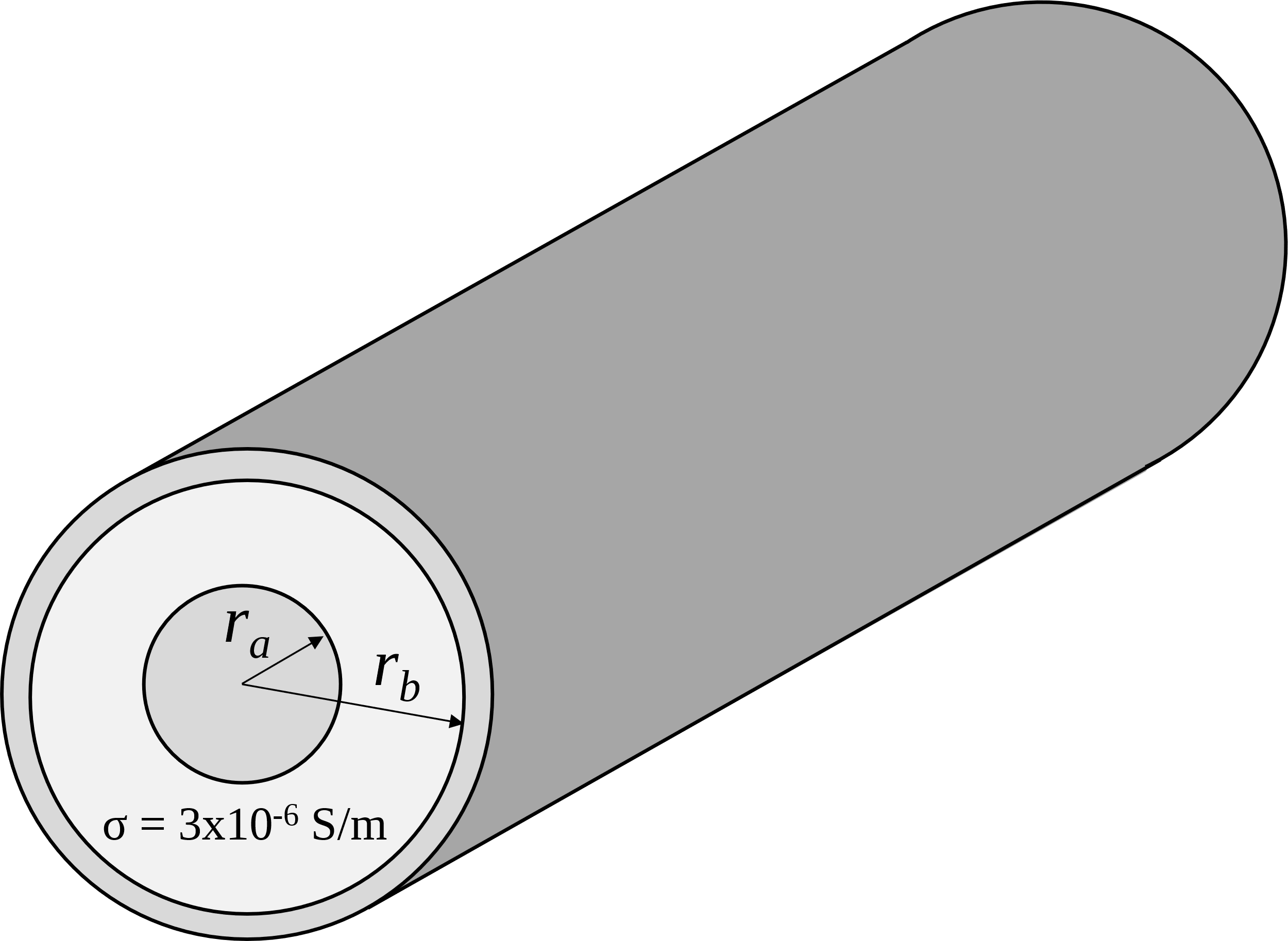
Determine the conductance per unit length of a coaxial cable with an inner conductor radius, ra, and an outer radius, rb. The dielectric between the two conductors has a conductivity, σ = 3 × 10⁻⁶ S/m.
If we assume a uniform current I flows between the two conductors, then the magnitude of the current density decreases as it moves from the inner conductor to the outer conductor because it is spread over an increasing area. By dividing the total current by this area, we obtain an expression for the current density,
where r is the radial distance from the center of the cable and l is the length of the cable. The electric field is found by applying Ohm’s Law,
.
and the voltage between the two conductors is found by integrating the electric field,
The conductance per unit length is the ratio of the current per unit length to the voltage,
Note the similarity between the expression for the conductance above and the expression for the capacitance per unit length of a coaxial cable,
The procedure for determining the capacitance between conductors is analogous to the method used to determine conductance. Instead of beginning with an electric flux due to static charges, we start with an electric current. Instead of a variable ε, which is the ratio of electric flux to electric field, we use the variable σ, which is the ratio of electric current to electric field. Generally, any expression for the capacitance of a configuration can be converted to an expression for the conductance by making the substitutions C→G and ε→σ.